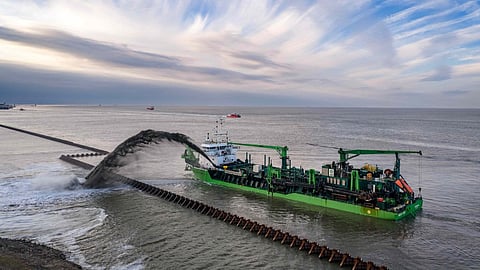
DEME has completed land reclamation for the offshore wind terminal expansion at the Port of Cuxhaven in Germany, with earthmoving still under way before the last dredging stage.
DEME is building the expansion for port authority Niedersachsen Ports with consortium partners Depenbrock, TAGU, and Boskalis.
The project adds berths five to seven between berth four at Europakai and berth eight at the existing offshore terminal. It will provide a 1,350-metre quay wall for heavy loads and 38 hectares of space for the terminal, designed particularly for onshore and offshore wind turbine components.
When DEME was awarded the contract in November 2024, it planned to reclaim more than three million cubic metres using two trailing suction hopper dredgers (TSHDs), a backhoe dredger and several barges.
The contract is valued at up to €50 million (US$55 million). In April, the TSHD Meuse River was rainbowing sand onto the site.
Berth five is designed for a water depth of minus 17 metres Normalnull (NN). Berth six is designed for minus 15.5 metres NN and berth seven for minus 13 metres NN. The terminal surface is rated at 15 tonnes per square metre.
The berths are designed for jackup vessels exerting leg loads of up to 100 tonnes per square metre on the seabed, and for ships up to 300 metres long.
Berths five and 6.1 and an adjoining terminal area of about 19 hectares are scheduled for completion in 2027. Berths 6.2 and seven and a terminal area of similar size are due in 2028 and will be operated by Cuxhaven Terminal, a project company of Blue Water Breb.
The development is budgeted at about €300 million (US$330 million). Federal and state regional development funding will cover up to €200 million (US$220 million), and the port industry is prefinancing the remainder through concessions.
