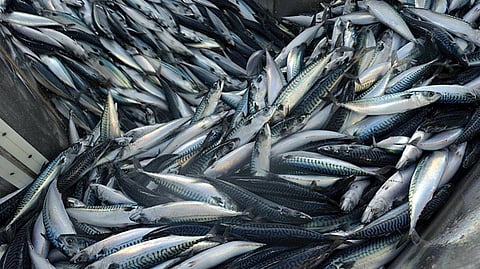

The International Council for the Exploration of the Sea (ICES) advised on September 30, that total catches of Northeast Atlantic mackerel in 2027 should not exceed 352,938 tonnes, more than double its advice for 2026.
It is about 11 per cent below ICES’ forecast of 398,186 tonnes for total catches this year.
The 2026 spawning-stock biomass is estimated at about 3.2 million tonnes, just above the 3.07 million tonnes critical limit reference point and still below the 4.12 million tonnes precautionary level.
The advice uses the maximum sustainable yield (MSY) method and covers all countries fishing the stock in the Northeast Atlantic and adjacent waters. It does not determine national quotas.
The Marine and Freshwater Research Institute said its latest assessment shows a modest rise in spawning stock compared with the previous year, partly due to stronger recruitment and higher average weights at age. It also noted that the stock remains low by historical standards.
Under the advised catch scenario, spawning-stock biomass is projected at 3,135,352 tonnes in 2027 and 3,345,872 tonnes in 2028, with a 33.2 per cent probability of falling below the critical limit in 2028.
The Scottish Pelagic Sustainability Group (SPSG), representing mackerel catchers and processors, welcomed the improvement but said further stock rebuilding was needed.
SPSG chair Ian Gatt said: “This includes the need to reach a quota shares agreement with all coastal states involved in the fishery.”
In December 2025, the UK, Norway, the Faroe Islands and Iceland agreed under their four-party arrangement to limit the 2026 total allowable catch (TAC) to 299,010 tonnes. The EU and Greenland remain outside the deal. ICES records no internationally agreed TAC for 2026.

