VESSEL REVIEW | Wakashio Maru – Survey and navigation training vessel for Japanese technology college
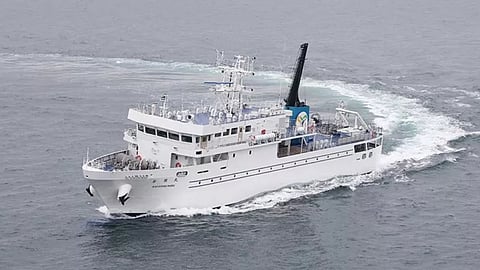
Japan's National Institute of Technology, Toyama College (NITTC) recently took delivery of a new training vessel built by Mitsubishi Shipbuilding.
Wakashio Maru (若潮丸) is the fifth training vessel to be acquired by NITTC, the fifth NITTC vessel to bear the name, and the college's first newbuild ship acquisition since 1995. She has an LOA of 56.48 metres (185.3 feet), a beam of 10.6 metres (34.8 feet), a depth of 5.95 metres (19.5 feet), a gross tonnage of 389, and accommodation for up to 60 people.
A diesel engine drives a fixed-pitch propeller to deliver a service speed of 12.5 knots.
Outfitted for hydrographic missions and providing seagoing instruction
Wakashio Maru will be used to provide practical training in ocean navigation for NITTC's secondary-level students as well conduct surveys and experiments for educational and community contribution purposes.
The vessel's research equipment includes an A-frame, a crane, winches, a fish finder, a multibeam echosounder, and acoustic measurement sensors that can be deployed at depths of as much as 1,000 metres (3,000 feet), allowing operation in Toyama Bay.
A remotely operated vehicle can also be carried on board along with plankton nets, cameras for taking photographs of undersea life, and water sampling equipment.
The onboard facilities include living quarters, toilets, showers, a navigational simulator, a training switchboard, and wooden decks for instructing crews in daily maintenance. The engines and the generator are kept in separate spaces so that trainees can become familiar with the differences in the sounds and vibration of the various onboard machinery.
The exterior of the superstructure is insulated to permit operation in the Sea of Japan even during winter. A damping device is also fitted to reduce pitch and roll while underway, thus minimising fatigue.
Can be equipped for disaster response
The vessel also has a secondary disaster response capability. Specifically, she is capable of supplying water and electricity to disaster-stricken areas, transporting relief aid, operating as a floating staging base, and providing temporary living spaces for displaced residents. To aid in her disaster response role, she has provisions for Starlink satellite communications equipment.
Wakashio Maru will be deployed on two-day and one-night sailing cruises as part of NITTC’s training curriculum beginning this month.
