
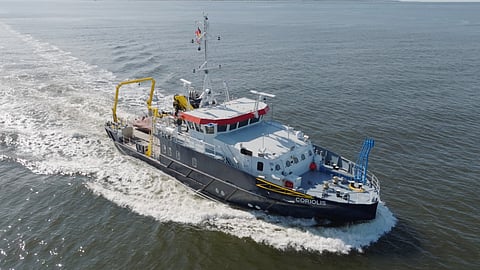
VESSEL REVIEW | Coriolis – Hybrid hydrogen-powered research vessel delivered to German science institute
German research institute Helmholtz-Zentrum Hereon has taken delivery of Coriolis, a new research vessel built by local shipyard Hitzler Werft.
Named after famed 19th century French scientist Gaspard Gustave de Coriolis, the vessel will be operated by Hereon’s Institute of Surface Science as a multi-disciplinary platform.
Hereon said she will cover a unique spectrum of coastal, materials, hydrogen and membrane research as well as set new standards in digitalisation. For example, she will be used to analyse which nutrients and pollutants are transported from rivers into the sea or how the expansion of offshore wind farms affects the environment.
All environmentally relevant research data obtained during the voyage can be retrieved in real time or shared directly with other ships and shore stations.
Multiple propulsion modes ensuring greater operational flexibility

Coriolis has a length of 29.9 metres (98.1 feet), a beam of eight metres (26 feet), a draught of only 1.6 metres (5.2 feet), and accommodation for two crewmembers and up to 12 scientists. Due to her compact size and low draught, she can easily navigate rivers, shallow water areas such as the Wadden Sea, and the deeper waters of the North and Baltic Seas.
The vessel’s propulsion system consists of electric traction motors that can access various power storage units. One of these is a hydrogen fuel cell and another is a specially developed tank system in which hydrogen is stored in the form of metal hydrides. This will enable the testing and establishment of hydrogen technologies in favour of more environmentally friendly shipping.
Hereon said that compared to the storage of hydrogen in liquid or compressed form, metal hydrides offer various advantages. One of these is that the prevailing pressures and temperatures are considerably more moderate.
In addition, the form of the tank storage can be designed to be highly flexible. It is therefore feasible to adapt the storage tank to the structure of a ship and thus achieve positive effects in terms of spatial utilisation or ship stability.
As sailing forces act far above the ship's centre of gravity, compensating for these forces and preventing the ship's hull from heeling excessively will require significant quantities of ballast water, which would otherwise be usually required in the hull. With the integration of metal hydride tanks, the unnecessary ballast mass can be replaced by a practical storage system for hydrogen as an alternative fuel.
The hydrogen onboard power system will fulfil a series of tasks including: supplying the onboard power during daily layovers in harbours; supplying onboard electricity during measurement campaigns in the North and Baltic Seas, including electricity for the measuring devices, echosounders, and other sensors; supplying power for the electric stern thruster and the bow manoeuvring pump jet; supply power for the main propeller (albeit only for short-term operation).
The electric motors can also draw power from an onboard diesel engine or batteries as backup for the hydrogen system. Hereon said that even when utilising the diesel engine, the vessel will be able to produce fewer harmful emissions thanks to a special membrane for the engine that separates nitrogen oxides from the combustion air.
The propulsion can deliver a top speed of 12 knots and a range of 100 nautical miles. The vessel can also operate for up to 225 days in a year, ensuring availability for research voyages of extended duration.
For research purposes, a 45kW diesel generator is combined with a membrane module developed by Hereon. This will ensure that the NOx emissions from the generator can be almost completely eliminated.
The drive is also redundantly designed, allowing the fuel cell, the battery and the generator to be combined with one another.
Multi-disciplinary laboratories including one dedicated to hydrogen research
The onboard facilities include a working deck with a stern A-frame and an area of 70 square metres (750 square feet) and various laboratories that cover a total area of 47 square metres (510 square feet). The hydrogen laboratory is located in the bow area near the propulsion system to enable the vessel’s embarked scientists to conduct tests on the hydrogen-based energy supply systems.
Scientists on Coriolis can take water and sediment samples and then analyse them for content and possible pollutants. Measuring probes are used from the wet laboratory and a variety of physical measurements are conducted.
The preparation of the measuring probes as well as the subsequent analysis of the measurement data obtained are analysed in the electronic laboratory. Buoys as well as ground-based measuring systems such as underwater nodes and landers can also be deployed from on board the vessel.
The equipment of the wet laboratory includes a hydrographic shaft with which scientific instruments can be deployed directly from inside the vessel to the keel line. The laboratory is also equipped with an ultra-pure seawater system for trace analysis.
The built-in FerryBox automated measuring system developed by Hereon can be registered online and can continuously measure physical, chemical and biological parameters such as oxygen concentration, salinity, temperature or pH value while underway and in port. Hydroacoustic systems for current measurement such as an echosounder and an acoustic Doppler current profiler are provided in the bottom of the vessel.
The vessel will feature instruments for flow measurement and various other flexibly deployable systems. She will also boast a completely new information and data management system to facilitate the exchange of relevant environmental data with aircraft, other ships, and shore stations in real time and make such data available immediately.
Coriolis has since replaced Ludwig Prandtl, Hereon’s earlier research vessel.
