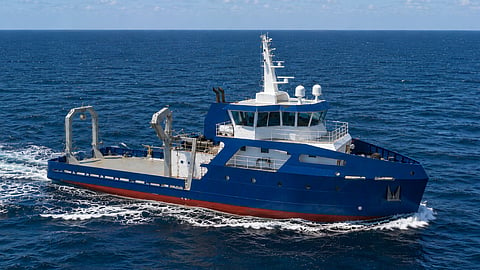

The University of California San Diego (UC San Diego) has entered into an agreement with Chilean shipbuilder Asenav for the construction of a new hybrid research vessel.
From its home port in San Diego, the 38-metre vessel will serve hundreds of scientists and students each year along the Eastern Pacific coast as part of the US Academic Research Fleet.
The NB 201 project, designed by Asenav, will replace Robert Gordon Sproul, the current coastal research vessel, which will be retired after nearly four decades of service.
The electrically propelled replacement research vessel will be able to carry up to 20 crew, students and scientists and will serve missions for UC San Diego's Scripps Institution of Oceanography. Asenav said it was selected after participating in the university's request for proposal process.
The project has an estimated timeline of 24 months and will cover a comprehensive scope of design, construction, testing, and trials through to delivery of the vessel, projected for July 2028.
Asenav said the ship will be capable of operating more than 200 days per year at sea to fulfil operations demanding high scientific, acoustic, and environmental standards.
The monohull vessel will be propelled by dual azimuthing L-drive stern thrusters and a bow thruster. Asenav said the advanced propulsion system will allow the ship to maintain precise control over its speed and position.
During expeditions, the vessel will operate at various working speeds: transit at 10 knots, survey at eight knots, towing at two knots, and maintaining exact positioning using dynamic positioning at low or no speed.
The ship will support crew and scientists on board for missions lasting up to eleven days at sea, with the ability to carry up to forty students on one-day educational deployments. The vessel will be designed to support up to 55 missions per year over 200 days at sea, operating 24 hours per day.
Intended as a general-purpose research vessel, the ship will include many different capabilities to support scientific missions in biology, chemistry, geology, geophysics and physical oceanography.
A suite of built-in acoustic systems will support seafloor mapping using multibeam and sub-bottom acoustic systems, as well as mapping ocean currents beneath the ship using acoustic Doppler current profilers and imaging fish and other biomass in the water column using multi-frequency midwater imaging sonars.
Using its dynamic positioning capability, the ship will be able to hold station for long periods while using its winches, crane and A-Frame to lower instruments as deep as 4,000 metres, or to conduct remotely operated vehicle deployments to the seafloor.
An ultra-short baseline acoustic navigation system will allow the ship to deploy and track autonomous underwater vehicles. Lastly, a computer network and communications systems will enable scientists and students to connect with their instruments on board and to the internet using satellite communications networks.
A key technical aspect of the project will be compliance with performance guarantees related to speed, range, power quality, airborne noise, exhaust emissions, and low underwater radiated
noise at survey speeds between 1 and 10 knots — a condition of particular importance to avoid interference with scientific measurements and the marine environment.
The vessel will feature hybrid battery propulsion and low-emission certifications, incorporating solutions designed to reduce the environmental impact of its operations. Asenav said the design will also include a mandatory UPS system for critical science, navigation, and mission loads, ensuring operational continuity for the vessel’s essential systems.
Integration into the US Academic Research Fleet will require compliance with a range of mandatory technical standards, including classification requirements of the American Bureau of Shipping, regulations of the US Coast Guard, and compliance with applicable federal, state, and local regulations in the United States.

