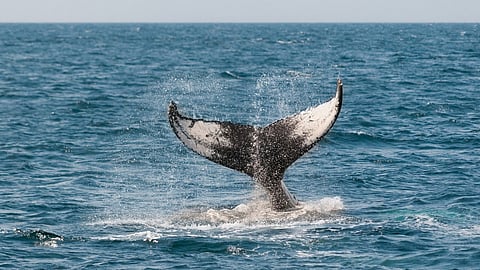


Increased activity by the fin whale - the world's second-largest whale species - along Chile's northern coast during feeding season is highlighting a growing threat of collisions with ships and fishing net entanglements, marine experts and conservationists warned this week.
The nutrient-rich waters of the Mejillones and Antofagasta bays typically see a rise in fin whales coming to feed between October and January.
At the same time, the region has become a global hotspot for maritime accidents involving whales, prompting advocates to call for stronger habitat protections.
"Chile appears to be the primary space where collisions are recorded," said marine ecologist Christian Guerra.
"We are leading negatively in terms of strandings and collisions compared to the rest of the world." The Antofagasta Cetacean Observation Network, a volunteer group, monitors the whales to mitigate these risks.
Alex Sanchez, a member of the network, noted that beyond ship collisions, fishing nets left adrift by large-scale operations frequently trap the mammals.
Visual evidence of the danger was seen recently in Algarrobo, further south of Mejillones and Antofagasta bays, where drone footage captured a whale carcass washed ashore earlier this month.
Silvana Espinoza, an ecosystem expert at Greenpeace, emphasised that the whales are essential for climate regulation and nutrient distribution.
(Reporting by Rodrigo Gutierrez Writing by Daina Beth Solomon Editing by Tomasz Janowski)
