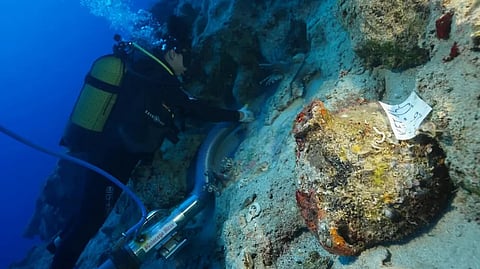

Archaeologists excavating a shipwreck near Kekova Island off Turkey’s Antalya province have dated the wreck to 4,400 to 4,700 years ago.
If confirmed, the date would make it the oldest known shipwreck.
More than 30 ceramic vessels used for storage, along with three stone anchors, have been recovered from the site, which lies about 30 metres below the surface. The wooden hull has not survived.
The research team has described the vessel as a small craft of about 10 metres in length. It is believed to have sunk while travelling east to west, probably carrying trade cargo.
With no timber left for radiocarbon dating, researchers dated the wreck by comparing the shape and decoration of the amphorae with Early Bronze Age examples from Egypt and the Middle East.
"Comparing the decoration techniques… we can definitely say our wreck is Early Bronze Age,” Hakan Öniz, who leads the excavation's scientific work, told the BBC.
A research team member writing in The Conversation called the estimate of around 2700–2400 BC preliminary and said earlier or later dates remain possible. At the proposed age, Kekova would predate the Dokos wreck off Greece, which is dated to about 4,200 years ago.
Mehmet Nuri Ersoy, Turkey’s Culture and Tourism Minister, said clay analyses indicate the amphorae were probably made in Jordan Valley workshops. Similar jars have been found in Egypt, Troy and Crete.
Researchers suggest the ship may have sailed from a Levantine port towards Troy or Crete.
The jars' contents have not been identified. Archaeologist Karin Sowada, who examined the recovered amphorae, told the BBC that a glossy residue found in some of them "could be olive oil, it could be wine, it could be tree resins."
It is not known whether the anchors, which were found at varying distances around the site, belonged to the wreck.
Akdeniz University documented the site during a survey in 2024. Full excavation began in 2026 under the Antalya Museum Directorate.
The artefacts are being conserved. Ersoy said they are intended for display at a new Mediterranean Underwater Archaeology Museum in Antalya.

