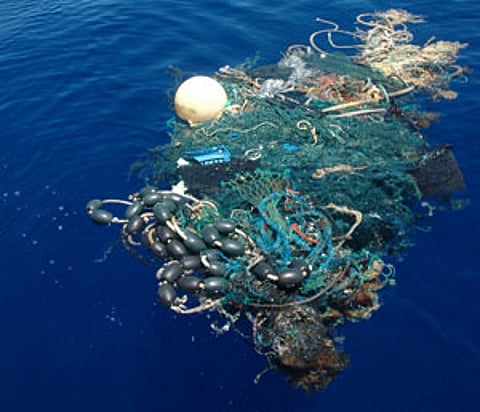

Researchers have found evidence of plastic waste in more than nine percent of the stomachs of fish collected from the North Pacific subtropical gyre. Peter Davison and Rebecca Asch from the Scripps Institution of Oceanography at UC San Diego estimate that fish in the intermediate ocean depths of the North Pacific ingest plastic at a rate of roughly 12,000 to 24,000 tonnes per year.
Marine debris is dispersed across thousands of miles of the North Pacific subtropical gyre. The region is a "convergence zone" where floating debris in water congregates. According to the New York Times, scientists are becoming increasingly concerned about the accumulation of disintegrating plastic waste in these marine "garbage patches", but research on the impacts on the marine environment has to date been inconclusive.
In August 2009 Scripps researchers travelled more than 1,500 kilimetres west of California to the eastern sector of the region aboard the research vessel 'New Horizon', in an expedition supported by the environmental NGO Project Kaisei. Researchers collected fish specimens, water samples and marine debris at depths ranging from the surface to thousands of feet depth.
Of 141 fishes spanning 27 species dissected in the Scripps study, plastic debris was found in the stomach contents of 9.2 percent of mid-water fishes, primarily broken-down bits smaller than a human fingernail. The researchers say the majority of the stomach plastic pieces were so small their origin could not be determined. "About nine percent of examined fishes contained plastic in their stomach," said Davison. "That is an underestimate of the true ingestion rate because a fish may regurgitate or pass a plastic item, or even die from eating it."
The authors said previous studies on fish and plastic ingestion may have included "net-feeding" biases. Net feeding can lead to artificially high cases of plastic ingestion by fishes while they are confined in a net with a high concentration of plastic debris. The Scripps study was designed to avoid such bias, using a surface-collecting device called a "manta net" for only 15 minutes at a time to minimise the risk of net feeding by preventing large concentrations of plastic from building up and reducing the amount of time that a captured fish spends in the net. The fishes were also collected with other nets that sample deeper water where there is less plastic to be ingested through net feeding.
The majority of fish examined in the study were myctophids, commonly called lanternfish. Such fish generally inhabit depths of 200 to 1,000 metres during the day and swim to the surface at night. "These fish have an important role in the food chain because they connect plankton at the base of the food chain with higher levels," said Asch.

