VESSEL REVIEW | Lyncee – Self-righting boat for pilotage duties in southern France
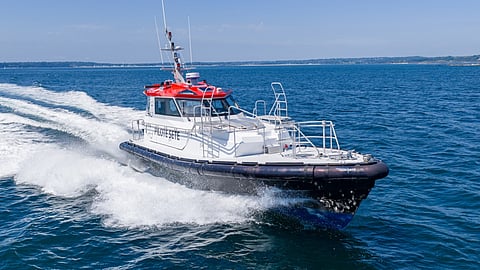
The maritime pilot station of Sète on France's Mediterranean coast welcomed a new all-weather pilot boat into service on September 15, 2026.
Lyncée was designed by Nantes-based naval architecture firm Archi Delion. Construction began at Chantiers Bernard in Locmiquélic, and the vessel was completed and outfitted by JFA Naval in Concarneau.
The 14.2-metre (46.6-foot) vessel replaces one of the Sète station's two all-weather pilot boats under a regulatory requirement for renewal every 15 years. The pilots financed the acquisition at a cost of €2 million (US$2.3 million).
The newbuild’s name refers to Lynceus, a figure in Ancient Greek mythology known for his ability to see great distances.
Enhanced variant of an earlier design

The French Maritime Pilots' Federation said the principal requirement was a versatile vessel particularly suited to conditions off Sète during southeasterly gales and the short, steep seas that accompany them. The station chose an existing Archi Delion design to diversify a fleet that had previously comprised two Pantocarène pilot boats.
In a 2021 interview, then-station president Gabriel Charpentier said Sète lacks sheltered boarding waters and that large swells build quickly in south-easterly weather. He put the number of particularly difficult operating days at 30 to 60 a year.
The station's pilots tested the Dunkirk pilot boat P XVIII, the first vessel built to the Delion design, at Calais in January 2021 before making their selection. Lyncée is the second boat built to the design, following P XVIII, which was delivered in 2020.
Archi Delion chief architect Pierre Delion said that the hull was designed to be self-righting, although this capability was not a requirement for the Sète version.
The brief for the second boat drew on observations from P XVIII's sea trials. Delion said his team improved a number of details, slightly reduced structural weight, and increased installed power to reach 23 knots.
"Great care was taken in distributing the weight on board to preserve the hull's well-known qualities, which have been demonstrated in several previous models," Delion told Baird Maritime. "We designed a hull that is very stable and reassuring in following seas without compromising its performance in head seas. Pilots need both for all their missions.
"It is interesting to note that pilots are the only shipowners who also sail as passengers on their own vessels and place particular importance on the boat's seaworthiness and onboard comfort during transfers so that they can focus on their duties as pilots."
Asked about the main design challenge, Delion said it was in designing a boat that is well-balanced and has the right weight to ensure its performance, stability, and seakeeping ability. The boat also needed to satisfy the requirements of, “not only the skippers but also the crew and those who maintain it."
Improved safety and ergonomics
The station said the design was adapted to the Gulf of Lion, the port's characteristics and its traffic.
The fixed ladder arrangement used for pilot boarding was revised to improve its ergonomics and the helmsman's visibility. The MOB recovery system differs from those on the station's other boats and is based on a concept developed by the Le Havre pilots, with the aim of simplifying recovery operations.
The wheelhouse is mounted on resilient supports to reduce noise and vibration. The vessel also has automatic stabilisers and a higher wheelhouse.
The boat was ordered from Chantiers Bernard in 2022. After the yard ran into difficulties, the owner transferred the composite hull and wheelhouse to JFA Naval, which resumed work in the spring of 2025 and installed the technical systems, deck equipment and outfitting. The vessel was launched at Concarneau on April 17, 2026.
"The biggest challenge is to control and comply [with] the designed displacement figure and comply with national rules, which [have become] more demanding," Gaël Douguet, Associate and Sales Manager at JFA, explained.
He also said the split between hull construction at one yard and fit-out at another added to the project’s challenges.
JFA said sea trials showed the vessel reached a top speed of 23 knots under load and found all onboard systems operating properly, while also confirming compliance with regulatory requirements.
The vessel was transported from Brittany to the Mediterranean by road. JFA said this avoided a passage around the Iberian Peninsula, a challenging route for a boat certified for third-category navigation. The final sea leg to Sète began at Gruissan, and the boat arrived at her home port escorted by a local all-weather rescue boat.
Custom propulsion and electronics fitout
Propulsion was specified by the architect and the pilot station. Lyncée has two Cummins QSL9 diesels, each rated at 335 kW (450 hp) and driving a five-bladed propeller through a conventional shaftline.
"It is quite conventional – engine plus shaft line plus a five-bladed propeller,” Douguet told Baird Maritime. “Reliability is the most important aspect [of the selection].”
The pilots selected and supplied the electronics, which comprise a GPS, VHF radios, a chartplotter and radar. The vessel is also fitted with an Ecomer fuel consumption measurement and reporting installation developed with the French Maritime Pilots' Federation. JFA said the system will be installed on all new French pilot boats, allowing consumption data to be gathered across the national fleet.
In place of railings, the deck has a track-and-car safety rail around the wheelhouse to which crew can clip their harnesses. Other deck equipment comprises pilot ladders with a large platform and substantial fendering.
The station said Lyncée met its expectations from her first trials and operations. She joins the all-weather pilot boat Saint-Louis, which was commissioned in 2018.
