
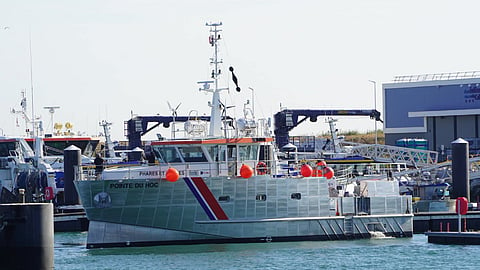
VESSEL REVIEW | Pointe du Hoc – Aluminium buoy tender takes on aids-to-navigation maintenance off Normandy
French marine services provider Armement des Phares et Balises (APB) took delivery of the aluminium buoy tender Pointe du Hoc on July 10, 2026, bringing into service a new coastal vessel built by Chantier Naval Delavergne of Avrillé, Vendée, for aids-to-navigation maintenance along the Normandy coast.
Registered at Cherbourg-en-Cotentin, the vessel replaces two older APB units, Le Cardennet, which has since been reassigned to Granville, and La Quervière, which was based at Cherbourg.
Delavergne launched the aluminium-hulled vessel at the commercial port of Les Sables-d'Olonne on February 25, 2026, after an 11-month build. The contract was awarded in November 2024.
The vessel has a length of 22 metres (72 feet), a beam of 7.5 metres (25 feet), a draught of only two metres (seven feet), and a displacement of 100 tonnes. Propulsion comes from two 450hp (340kW) engines.
Deck fitout optimised for navigation aids servicing and maintenance

The working capability of Pointe du Hoc depends on its deck machinery.
The vessel is fitted with a crane and a winch rated to recover buoys of up to 400 kg and to replace mooring chains of up to 30 metres (100 feet). That capacity covers the routine tasks of a coastal tender: lifting damaged or drifted buoys, replacing worn chain, and servicing lights at port entrances.
The new vessel's lifting limit was demonstrated within weeks of delivery. A buoy was missing from the Ouistreham channel when the vessel called at the port in late July, and its replacement was assigned elsewhere.
"Its replacement will be handled by a buoy tender based at Le Havre, since the buoy weighs more than three tonnes and requires a more powerful vessel," Jérôme Leduc, the vessel's second-in-command, told Ouest-France.
Capable of extended-duration operation
The vessel is arranged with accommodation for multi-day missions and operates with a crew of six. Its beat extends from Diélette, on the western side of the Cotentin peninsula, to Le Havre in Seine-Maritime, a stretch that takes in Cherbourg, the Calvados landing beaches and the Seine estuary. When working the Calvados coast it berths at Quai Charcot in Ouistreham.
The crew is responsible for 178 lights and buoys at sea and ashore in the Ouistreham sector, and a further 193 in the Cherbourg sector. Leduc said the vessel would carry out around 50 interventions a year.
"Our work consists of replacing the buoys that are damaged or have moved and the lights that are not working at the entrance to ports," Leduc said. "The interventions are often triggered after reports from recreational boaters, captains or pilot stations."
The vessel takes its name from the clifftop promontory between Utah and Omaha beaches on the Calvados coast, within its own operating area.
