
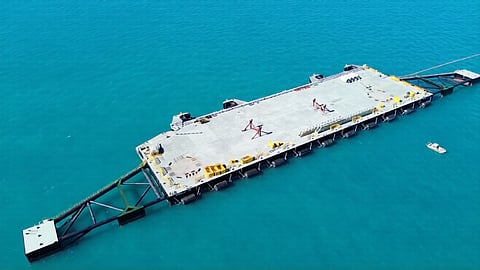
PLATFORM REVIEW | Kimberly Link – Tide-following floating wharf expands heavy-lift berth capacity at Australia's Port of Broome
Kimberly Link, the floating wharf at the Kimberley Marine Support Base's (KMSB) Terminal Two in the Port of Broome in Western Australia, is the centrepiece of a AU$200 million (US$140 million) privately funded terminal built by lead contractor Total AMS (TAMS) and designed in part by OSK Design, which was responsible for the wharf, dolphins and restraint structures.
The pontoon was launched at Nantong Rainbow Offshore and Engineering Equipment in China before being towed to Broome, and joined to its shore connection later in 2025. KMSB took its first scheduled cruise call, Scenic Eclipse II, on September 17, 2025, days after the opening.
The wharf addresses Broome's large tidal range. The TAMS Group project description gave a range of up to 10 metres (30 feet) within six hours, and BigLift Shipping, which installed the main fixed components, recorded fluctuations of up to eight metres (26 feet) at the site.
TAMS said the port's existing wharf was designed for an earlier generation of trade and left many operations dependent on brief tide-related openings, reducing efficiency and making it harder for larger ships to work.
Capable of handling a broad range of cargo and vessel types

KMSB's completed-facility material puts the pontoon's mass at more than 11,500 tonnes, its beam at 50 metres (160 feet), and its deck area at 9,250 square metres (99,600 square feet). The 265-metre (869-foot) berth line incorporates the northern and southern dolphins.
The wharf sits in a naturally deep berth pocket, given by KMSB as between -15 and -16 metres lowest astronomical tide. Because the depth was already available, the project required no dredging, and KMSB and TAMS both cited reduced seabed disturbance as a design outcome.
OSK Design said the location was settled after consultation with Broome stakeholders with the aim of minimising the disturbed footprint.
With the dolphins included, the berth can take ships up to 348 metres (1,140 feet) in LOA, and KMSB said it suits Ro-Ro, platform supply, container and breakbulk vessels of Panamax-plus dimensions. Dynamic and static mooring studies have been completed for 200-metre (660-foot) and 235-metre Ro-Ro ships.
The pontoon is held on station by two restraint jackets, which allow vertical travel while resisting lateral loads from wind, current and berthing.
BigLift shipped both jackets from Taicang, China, aboard the heavy-lift vessel Happy Star in May 2025. Each jacket measured about 28.5 by 22.2 by 23.1 metres (93.5 by 72.8 by 75.8 feet) and weighed roughly 790 tonnes. The same voyage carried the 890-tonne linkspan bridge, a 160-tonne southern fixed dolphin measuring 12 by 12 by 9.4 metres (39 by 39 by 31 feet), as well as piles, walkways and temporary works for the installation.
With Happy Star held in its mooring spread, it lifted the two restraint jackets and the southern dolphin onto pre-driven piles, maintaining at least 0.5 metres of under-keel clearance throughout. BigLift said the combination of shallow water, strong currents and narrow neap-tide windows required tight control of the lift sequence.
The linkspan went onto a barge for later placement, floating dolphins were fitted to the pontoon and loose materials were landed on the existing quay.
Compatible with Broome's existing port infrastructure and equipment
TAMS said jack-up barges and rigs were used for seabed surveys and piling. After offshore fabrication, marine cranes lifted the pontoon modules into position, where hinged connections joined them into one continuous platform; fenders, bollards and mooring gear were then fitted. The facility was commissioned through load tests and trial berthings.
The shore connection is a fixed, two-way trestle causeway ending in a linkspan that takes up the relative movement between the floating deck and the abutment. KMSB said triple and quad road trains can use the causeway, and TAMS said services were run along its length so that fuel, water and power reach the berth.
On deck, KMSB specifies a high-load-bearing surface with a dedicated heavy-lift zone. The mobile crane fleet listed for the terminal includes a 125-tonne mobile harbour crane plus 30-, 60-, 100- and 300-tonne mobile cranes, with forklifts rated at three, 4.5, 10 and 16 tonnes. Design capability for breakbulk and project cargo extends to single lifts of 600 tonnes.
About 5,400 square metres (58,000 square feet) of the wharf is set aside for just-in-time staging.
Bunkering is by marine-grade diesel at up to 3,333 litres (733.2 gallons) per minute, and potable water can be loaded at up to 100,000 litres (22,000 gallons) per hour.
Shore power is available at the berth, licensed contractors handle oily waste and grey and black water, and LED floodlighting covers night work. KMSB said portable and static firefighting systems were nearing completion of commissioning when its specifications were published, and emergency response is coordinated with the port authority and regional services under a memorandum of understanding.
Landside, a sealed road via Port Drive links the wharf to roughly 17 hectares of laydown about one kilometre away, part of more than 20 hectares of hardstand under staged development, with the Great Northern Highway about five kilometres from the gate.
KMSB said the route has been surveyed for its curves, gradients and powerline clearances to accommodate modules and wind-turbine blades longer than 90 metres.
There is no rail connection. The developer's case rests on shortening supply chains that currently run through Fremantle or Darwin.
For cruise passengers, the practical change is at the gangway. Cruise Broome Chairman Shayne Murray said that two gangways could now be used without the tidal delays of the old berth, with passengers walking straight onto waiting coaches.
Broome still requires a dedicated passenger terminal, and the Kimberley Ports Authority has described Terminal Two as complementary to the existing wharf, which lies about 180 metres (590 feet) to the north, rather than a replacement for it.
The Kimberley Ports Authority has agreed to a suite of long-term commercial arrangements with KMSB, including provision of stevedoring during the first five years of operation.
The WA State Government has reported that the Australian Federal Government had granted in-principle approval for First Point of Entry status at Broome; KMSB said it is targeting formal designation within 12 to 18 months of opening.
