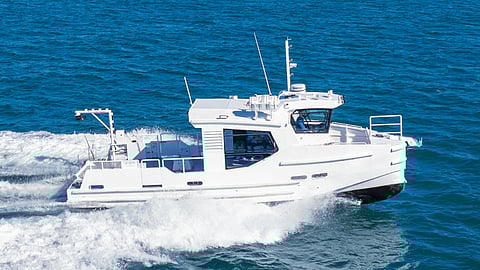


This compact, hybrid all-aluminium marina workboat was built by the French-managed, China-based yard ODC Marine for an ambitious Saudi urban development project on the Red Sea.
Eejeeya supports demanding marina duties—superyacht servicing, transfers, and utility tasks—with a 1,500-hour annual duty cycle, emphasising reliability, environmental sustainability, and protection in high-value yacht operations.

"She successfully combines three usually conflicting requirements in a very compact 12-metre platform: high cargo capacity, hybrid propulsion, and superyacht-level service standards," Stéphane Gonnetand, CEO of ODC Marine, told Baird Maritime.
"She reflects a new generation of workboats aligned with ambitious environmental and operational targets. Despite her 11.75-metre length, she can carry up to five tonnes of combined deck and below-deck cargo while integrating a hybrid propulsion setup of two diesel engines and two 20kW electric motors with a 63kWh LFP battery pack."
Gonnetand said that what truly sets the vessel apart is her ability to operate silently in electric mode inside the marina for up to three hours at 5.5 knots while still delivering offshore performance with a cruising speed of 12 knots under load and a top speed of 18 knots.
"In addition, she is specifically engineered to berth safely alongside superyachts, with dedicated fendering and access arrangements, making her both a high-performance workboat and a refined service platform."
Gonnetand said the biggest challenge in the construction lay in integrating a high-duty-cycle hybrid system, a five-tonne cargo capacity, deck equipment, and acoustic comfort into such a compact hull.
"At around 12 metres long, every centimetre matters. Achieving performance targets while maintaining proper soundproofing required very precise engineering trade-offs, particularly around transmission systems, pumps, and ventilation."
Reducing acoustic impact when operating in electric mode was another objective of the construction phase, and Gonnetand said the result in this area was remarkable, as evidenced by the onboard experience (when in electric mode) being closer to that of a sailboat than a traditional workboat.
"What made this project particularly demanding and rewarding was the level of coordination required between naval architecture, systems engineering, and production teams," Gonnetand remarked. "Integrating complex hybrid architecture into a compact professional platform left no margin for approximation. It required rigorous planning, constant dialogue, and strong internal discipline."
He added that one key lesson was the importance of systems integration from the earliest stage of the design phase. ODC Marine therefore introduced its new-generation monitoring system with dual touchscreens centralising all vessel data and controls. This system provides greater redundancy and faster response times and is now becoming a standard feature in the company's hybrid and electric vessel builds.
Eejeeya was developed to guarantee a high utilisation rate, which Gonnetand said is a trend impacting shipbuilding, along with operational efficiency, reliability, and predictable operating costs.
"At the same time, decarbonisation is increasingly embedded in that equation," he told Baird Maritime. "Environmental performance is no longer a secondary consideration; it instead directly influences asset value, regulatory compliance, and financing conditions. Owners and their financing partners expect measurable reductions in emissions, noise, and local pollution."
Gonnetand said this is particularly visible in sensitive marina environments and large-scale developments such as the boat's area of operations in Neom, where acoustic impact and environmental footprint are critical. Hybridisation and optimised propulsion architectures are emerging as practical solutions that reconcile operational flexibility with environmental responsibility.
"Another decisive trend is lifecycle optimisation. The focus has shifted from initial capex to total cost of ownership. Simplicity of design, system robustness, ease of maintenance, and long-term durability are now essential, and good value for money is achieved through intelligent engineering, not through unnecessary technological complexity."
Digital monitoring and smart system integration have also become key enablers, in Gonnetand's view. Real-time data and predictive maintenance improve reliability, reduce downtime, and provide transparency in both performance and environmental metrics.
"These are precisely the areas within which we are working extensively to strengthen and consolidate our expertise, ensuring that economic efficiency, operational reliability, and environmental responsibility progress together in a coherent and practical way."
Eejeeya was one of six vessels ODC Marine delivered in 2025, which Gonnetand said was a strong year for the company.
"We delivered six vessels — four passenger boats and two workboats — confirming both the stability of our production capacity and the continued trust of our clients. Among them were one fully electric vessel and two hybrid units, illustrating the technological breadth across which we now operate."
Gonnetand said that what clearly distinguished 2025 from previous years were positioning, complexity, and volume. Consequently, the vessels delivered by ODC Marine were larger, more technically demanding, and more integrated compared to earlier years.
"Clients are no longer simply purchasing a boat; they expect a complete operational solution combining performance, reliability, lifecycle efficiency, and long-term durability," Gonnetand remarked.
"This evolution is the result of a progressive strengthening of our internal capabilities over the years. Our teams have gained experience in managing more complex integrations and higher-performance platforms, which naturally allows us to take on more ambitious projects while maintaining discipline in execution."
ODC Marine has also launched two new projects, including one in the Middle East, involving significantly larger and highly innovative vessels. Gonnetand said these projects represent an important step forward in terms of scale and engineering capability.
"Strategically, the shipyard will continue to position itself on larger and more complex professional vessels," Gonnetand told Baird Maritime. "This evolution is deliberate: it reflects both market demand and our ambition to further consolidate our expertise in high-performance, high-value platforms."
He added that the integration of hybrid and electric propulsion continues to grow, but always within a broader framework of operational efficiency, robustness, and value for money. Sustainability is therefore fully integrated into the company's engineering approach rather than treated as a standalone objective.
"Overall, business is healthy and evolving in the direction we anticipated, as indicated by higher value-added vessels, greater technical integration, and expanding international exposure. We remain confident about the future. The market is becoming more demanding and more performance-driven, and this dynamic aligns well with our long-term strategy."
ODC Marine's evolution, as mentioned by Gonnetand, is timely, as he also believes the multi-purpose workboat industry is moving toward hybridisation, modularity, and digitalisation. Hybrid propulsion will increasingly become standard for marina, port, and nearshore operations. Battery technology will improve, but the key will be intelligent energy management systems that optimise duty cycles.
"We also expect stronger demand for compact vessels capable of performing multiple roles — cargo handling, passenger transfer, yacht services — within a single platform. Space optimisation and multifunctional deck layouts will be critical. Acoustic comfort will also become a differentiating factor, especially in premium environments."
As for the workboat industry in China, Gonnetand commented that it is entering a new phase — one marked not only by scale, but by increasing technical sophistication and innovation.
"Over the past decade, we have seen a significant rise in engineering capabilities, industrial efficiency, and quality control standards. Today, the Chinese shipbuilding ecosystem combines strong production capacity with rapid adoption of new technologies, particularly in electrification, battery systems, digital monitoring, and smart manufacturing processes.
"As a French-owned company that has been operating in China for nearly 20 years, we experience this evolution firsthand. The growing maturity of the local industrial environment directly benefits companies like ours and allows us to combine European engineering standards and design philosophy with a highly efficient and innovation-driven industrial base."
Gonnetand and his team believe that China will continue to strengthen its position in hybrid and electric propulsion, supported by its leadership in battery manufacturing and power electronics. At the same time, increasing quality expectations — both domestically and internationally — are pushing the industry toward higher-value, more technically advanced vessels.
"For ODC Marine, this dynamic environment is a major asset," he told Baird Maritime. It enables us to deliver innovative, high-performance vessels while remaining competitive and agile in a fast-evolving global market."
Meanwhile, Gonnetand has observed that France's own workboat industry has been developing its own strengths.
"France is widely recognised as one of the international references when it comes to well-designed and effective regulatory frameworks for coastal vessels, both workboats and passenger boats. French standards are demanding yet pragmatic, ensuring high safety levels while remaining operationally realistic. This has helped shape a dense and technically strong domestic market."
Gonnetand said the French professional vessel sector is characterised by a concentration of specialised shipyards, naval architects, and advanced equipment suppliers. This ecosystem therefore naturally favours high-value, highly customised vessels, where engineering precision, regulatory expertise, and innovation are critical differentiators.
"We see sustained interest in hybridisation and energy efficiency, particularly in coastal operations. In addition, some French companies are recognised internationally for their innovation in digitalisation and dronisation. Autonomous systems, remote monitoring, and intelligent fleet management are areas where French expertise will contribute to future global developments."
Gonnetand remarked that France’s industrial model is particularly well suited to technically complex vessels, bespoke projects, and innovation-driven platforms.
"In segments requiring strong industrial optimisation, short-series efficiency, or more standardised production logic, other industrial ecosystems may be structurally better positioned. This complementary positioning within the global market reinforces France’s role as a reference for high-value engineering and advanced maritime solutions."
For a list of the 2025 "Best Of" award winners, please click here.
