
As for any new type of ship, most ships with small water-plane area, SWA ships, have had small displacements. Some restrictions on small-sized SWA ship displacement and achievable speeds are described. The seaworthiness of small-sized SWA ship is described in comparison with equivalent catamaran. An example of a SWA patrol ship with a helicopter is shown and described.
Today, about 70 examples of small water-plane ships (SWA ships) have been built by various shipyards. As usual, the development of a new ship type starts on a small scale with reasonably low cost vessels; this means a small enough financial loss if the design is not a successful one.
Full-scale and model tests, systematic calculations, concept designs of small- and middle-sized SWA ships allow some restrictions on real dimensions and maximum speeds to be evaluated as well as their applicability from a seaworthiness point of view.
1. Minimum dimensions and speeds
Based on existing experience with model and full-scale tests, the usual twin-hull SWA ship (SWATH) is rational from a propulsion point of view, at Froude, numbers defined as a function of hull length of no more than 0.9–1.0 (with higher speeds leading to problems with dynamic attitude). Even special hull shapes and partial unloading by foils, which have been proposed by the author, can increase the relative speed by up to 1.2–1.3 (or a Froude number as a function of hull displacement of about 3.0), but no more.
Any triple-hull SWA ships must have lower achievable speeds. A triple-hull ship of equal hulls is most effective from a propulsion point of view, if a favorable interaction is ensured with the generated wave systems. But it is possible only for Froude numbers as a function of hull length of no more than 0.7.
And the hull length of a triple-hull vessel is smaller than that of a twin-hull vessel, even with the same hull aspect ratio. A vessel with a SWA main hull and two smaller side hulls (outriggers), which is named a "trimaran" in the English language technical literature, is restricted by Froude numbers defined as a function of the outrigger length to no more than 1.0–1.2, because higher speeds lead to an unacceptable growth in the spray resistance of the outriggers.
Also, the outriggers of such ships are always sufficiently shorter than the single hulls of twin-hulled SWA ships, i.e. the achievable speed of an outrigger ship is smaller than that of a twin-hull one.
1.1. To give one living deck at a height of 2.3–2.5 m over the platform connecting the SWA hulls, a displacement of no less than 15 to 20 tonnes is needed. This implies an arrangement where the main engines (and electric station) are also on the platform. Hydraulic power transmission is most efficient for such a vessel. Then, the achievable speeds are about 25 to 30 knots. The referenced book (Dubrovsky & Lyakhovitsky, 2001) contains an example of such a SWATH vessel used as a mini-ferry or motor yacht designed for Sea State 3.
1.2. If the main engines are arranged in the lower volume parts of the hulls (gondolas), the strut beam must be no less than one metre, and the gondola height no less than 2.3 to 3.0 metres. This implies a displacement of the twin-hull SWA ship of about 150 to 200 tonnes and speeds of about 35 to 40 knots can be achieved.
1.3. Displacement values up to 150 to 200 tonnes imply an engine arrangement on a platform above the water level. Displacements greater than 20 tonnes cause problems with the transmission of power to the propulsion systems. Electrical transmission is sufficiently heavier and more expensive; angular gears are not so reliable and also expensive. Very high speeds lead to power transmission problems for SWA ships with displacements up to 150 to 200 tonnes.
The referenced paper (Dubrovsky, 2008) contains an example of a SWATH vessel designed as a luxury motor yacht for design Sea State 4 (full displacement of about 130 tonnes).
2. It should be noted that improving the seaworthiness is most important for small- and middle-sized SWA vessels. Improving the seaworthiness of large-sized SWA ships is not so important from the part of operational time at sea point of view.
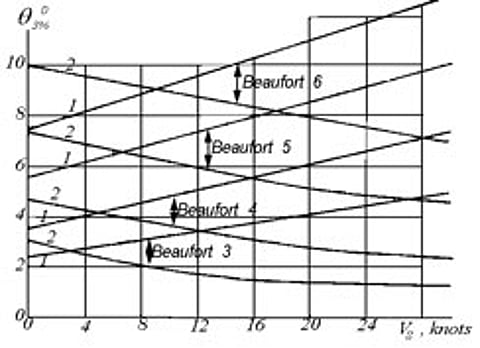
Figure 1 shows the pitch amplitude of a catamaran and a twin-hulled SWA ship of the same displacement (100 tonnes) in head waves (Dubrovsky & Lyakhovitsky, 2001).
The vessels have no motion stabilisers. It should be noted that the comparison is approximate because a catamaran of the same deck area will have slightly smaller displacement and higher speed in smooth water for the same power.
It should be noted that the dependence of amplitude on speed is different for the catamaran from the SWA vessel: the pitch amplitude of the catamaran rises with increasing speed while the amplitude of the SWA ship drops with increasing speed. The reason is a two times smaller own pitch frequency for the SWA vessel compared with the catamaran.
If the permissible level of pitch amplitude is, for example, four degrees, then the catamaran must decrease its speed by up to 18 knots in Sea State 3, but a SWATH has no restriction on speed. For the same amplitude restriction in Sea State 4, the catamaran must have a speed no more than four knots, while the SWATH's speed must be no less than eight knots (there is no upper restriction on speed from pitch amplitude point of view).
But we have a different situation for vertical acceleration of pitch in head waves, Figure 2.

If the permissible level of the acceleration is, for example, 0.25g, then the catamaran can travel at a speed of about three knots in Sea State 3, while a SWATH has no restriction on speed. The catamaran cannot travel in Sea State 4, but the SWATH can travel at a speed of about twelve knots.
It seems evident that acceleration, not pitch amplitude, is the main reason for speed restrictions for such small-sized vessels.
In addition, one of the main characteristics of SWA ships is the very high effectiveness of motion stabilisers (usually active horizontal rudders on high speed vessels), because the external disturbing forces and moments in waves are proportional to water-plane area. This means that the forces and moments generated by motion stabilizers are more comparable with the disturbing loads.
With regard to the application of full-scale SWA ships, it can be supposed that the previously examined 100-tonne SWA vessel can operate in Sea State 4 while all comparable vessels of traditional shapes can only operate in Sea State 3. This means a corresponded growth of comfortable enough sailing even in coastal regions of seas.
3. Nowadays, one of most interesting ships for many fleets is a patrol vessel with a helicopter. Such a SWATH ship is proposed below. A NATO helicopter (full weight 15 tonnes) was assumed for the purpose of designing the ship.
The ship differs from other alternatives in the following sufficient details:
The outer longitudinal stiffeners are supported by inner knees near the transverse bulkheads and are welded through wet deck plating. Such design solutions ensure a minimal mass for the hull structures and the slamming pressure is reduced for long service in stormy seas.
The 1,000 tonne SWA patrol ship with steel hull structure has a deadweight of up to 200 tonnes, the main engines are two diesel units generating a power of two 7.5MW at a full speed of 25 knots; the range is about 3,000km at a speed of 18 knots. Two gas turbines (total power 20MW) can generate speeds up to 30 knots. The overall dimensions are 55 x 20 x 14 metres, design draught, five metres. Such a ship is capable of helicopter operations at Sea State 5 without changing of course, and Sea State 6 with optimal course selection. For example, Fig. 7 shows an approximate estimation of bow vertical accelerations in a head sea.
Conclusion
Small-sized SWA ships are seaworthy at higher speeds than corresponding vessels with traditional shape, and SWA ship speeds are degraded sufficiently less for service in seas without ice in severe sea conditions
Victor Dubrovsky
References
Dubrovsky, V. and Lyakhovitsky, A., 2001, "Multi Hull Ships", ISBN 0-9644311-2-2, Backbone Publishing Co., Fair Lawn, USA, 495p.
Dubrovsky, V., Matveev, K. and Sutulo, S., 2007, "Small Water-plane Area Ships", Backbone Publishing Co., ISBN-13978-09742019-3-1, Hoboken, USA, 256p.
Dubrovsky, V., 2008, "A few words on small-sized SWA motor yacht", Brodogradnja, vol. 59, issue 4, pp.397–399.
