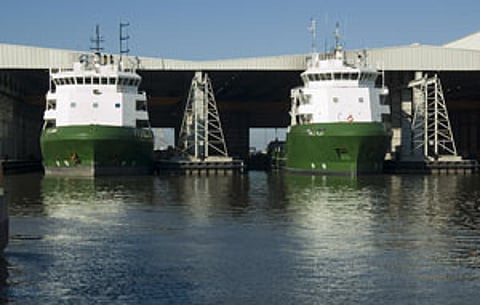

USA: The Seattle-based naval architect firm, Guido Perla and Associates (GPA), has become well known for their PSVs utilising diesel electric propulsion. The vessels have been well received in the industry with all of the vessels going to work as soon as they have been delivered from shipyards in the USA and China.
GPA had long promoted the technology but it was not until Larry Rigdon launched Rigdon Marine Inc in 2002 that they found a client to match their enthusiasm. The first of the new Rigdon vessels went to work in June of 2004 and the demand for more has not stopped ever since. When Rigdon Marine was sold to Gulf Mark Offshore in 2008 the company had 20 diesel electric PSVs.
Bourbon Offshore is in the second year of a 76-vessel order of GPA OSVs and AHTS vessels. These are being delivered at the rate of one about every eleven days from Zhejiang and Dayang shipyards in China, assuring that the technology will gain a lot more exposure in the global market.
GPA designer Dan Koch recently explained some of the advantages that diesel electric systems can bring to the marine environment: "A vessel's power systems should be designed to meet the particular operating modes of that vessel," he said. "GPA started considering this when designing the large factory trawlers for the Alaskan fishery where there were large electrical demands for freezing as well as propulsion, however, the industry wasn't yet ready.
"Later we designed casino boats where the electrical needs of the slot machines and other "hotel" services were primary and propulsion was secondary."
When GPA became involved in the offshore oil industry, the company saw a ready made role for diesel electric in the vessels that spend a good part of their time standing-by off oil platforms.
GPA takes on DP2
When customer demand for Dynamic Positioning 2 was added with full redundancies, the diesel electric advantages became even more pronounced.

The components of a diesel-electric system, as designed and recommended by GPA are:
1. A set of three or more diesel-powered electric generators
2. Propulsion switchboard with power management software
3. A variable speed drive
4. Electric motors with azimuthing thrusters
The diesel generators on boats such as the Rigdon/Gulfmark GPA654 are a pair of Cummins KTA-50(D)M1-powered 1,235kW and one Cummins KTA-19(D)M1-powered 425kW set.
Mr Koch calls this the father-son arrangement and it can work well for the varied operational profiles of the vessels. With this system, a PSV holding position under an oilrig in DP2 mode would have the two larger generators running. They would feed current to the bus which would send it on to the driver.
GPA favours the use of variable speed drivers which are the heart of the system. This in turn allows a variable speed motor to allow full control of the azimuthing drive propulsive power without adding the complexity of controllable pitch propellers.
Each variable speed drive provides the power requirements of the two z-drives and the two bow-thrusters to turn the propellers in such a manner as to keep the vessel in position.
Also, in the event that a problem causes one of the generators to go off line, the second generator would be able to handle the load to maintain the dynamic positioning function, as the redundancy demanded by DP2 requires.
Working in the DP mode with these redundancy requirements, GPA calculates that there is about a 30 percent load factor with the three-generator arrangement.
"Our goal is to optimise the machinery with the requirements of the ship," Mr Koch emphasised, "which may require additional generators to provide smaller increments of power, or other energy storage devices".
In another role, where the PSV is serving as a survey vessel and is towing sonar-type devices at slow speeds for hours on end redundancy is no longer required. In this mode, the load percentage has been seen to increase from 35 to 40 percent.
If the boat is holding position in calm waters, the smaller genset alone may be able to provide the required power without any redundancy or spinning reserves required. The idea with diesel electric, in applications with variable power needs, is to have multiple increments of available power.
"We try to balance initial capital costs with fuel savings over time. GPA 654 vessels are showing a 13 to 19 percent fuel saving over all for time at sea," Mr Koch said.
Diesel electric is not always the best choice. If a vessel is designed to go only from point A to point B, a mechanical drive may be better. Mechanical drives like a gearbox, shaft and propeller will lose about three percent of their power in the transmission of that power from engine to propeller.
An electrical drive may lose seven to nine percent between engine and propeller. However, there are factors that may influence an owner to select diesel electric. The GPA654 vessels were the second generation of GPA PSVs and had their main engine packages, the two Cummins 38-litre and the one 19-litre powered generator sets, placed on the main deck level.
This is possible because the electric motors are mounted at the stern on the top of the three propulsion propellers there and in the bow adjacent to the two bow thrusters. Putting the engines on the main deck level frees up the hull spaces resulting in a very significant 30 percent increase in cargo capacity. It also gives the added benefit of easier access to the engine spaces for service.
New technology emerges with Chinese-built boats
Another advantage of the diesel-electric systems used by GPA emerged with the Chinese-built boats. Initially the shipyards were not comfortable with some of the technology. As a result, the engines and generators were mated and mounted on skids. This task was accomplished by Cummins Mid-South at their Louisiana facility where they had put the Rigdon package together. These were then transported to the Chinese shipyards where they were soft mounted on the deck of boat under construction. Similarly the control units are pre-fabricated in a container that is then transported to the yard to be installed as a unit. This assures quality control but also speeds construction.
Diesel electric power is finding acceptance in a variety of applications that GPA is working on. A number of the 54-metre vessels building in China for Bourbon are being outfitted as 80-tonne capable anchor handlers. These are designated GPA254. In Brazil, two companies are building some diesel electric functionality into crew boats. These will be 50-metres-long and powered by four Cummins KTA50 M2 main engines delivering 1,267kW each through mechanical shafts to propellers.
However, when working in DP mode, two of the engines can be declutched so that they can power front-mounted generators that will drive electric motors for the bow thruster.
Meanwhile the other two engines will continue to provide propulsion through slipping clutches as a part of the dynamic positioning system.
"At GPA our thinking on diesel electric power continues to evolve," said Mr Koch. " We are now recommending that PSVs be built with four or even five smaller engines in order to take advantage of smaller increments of power. There is also the possibility of storing power using technologies like flywheels and or batteries to provide transitional power for the few seconds necessary to bring another diesel engine online to meet DP2 requirements."
