VESSEL REVIEW | Sardine – Russian-built compact USV for surveys in harsh environments
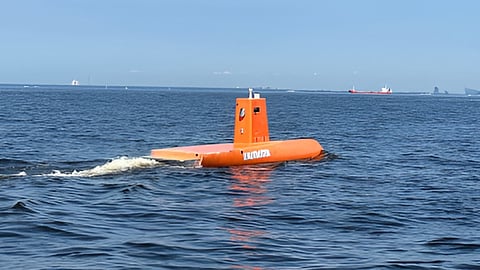
Russian robotic systems manufacturer Navis has introduced a new compact unmanned surface vehicle (USV) built primarily for hydrographic survey applications.
Sardine (Сардина; Sardina) is being marketed as a survey solution for operation under conditions wherein the use of traditional manned vessels would be impractical due to cost, remoteness, or risks to crew safety.
The USV can be deployed directly into the water from shore or from a vessel of opportunity, ensuring operational flexibility.
Highly stable platform that can withstand offshore conditions
The 6.4- by 1.3-metre (21- by 4.3-foot), 1,200kg USV boasts a wave-piercing hull that can generate only minimal pitch and roll while a draught of only 1.3 metres will permit navigation in otherwise restrictive nearshore waters. The wave-piercing ability allows the craft maintain a more stable attitude, thus minimising the risks of errors while it is gathering data even in wave heights of two to three metres (seven to 10 feet).
In its standard configuration, the craft is fitted with a 200-litre (44-gallon) fuel tank to deliver a range of 200 nautical miles or a maximum operating endurance of 30 hours.
Additional fuel tank capacity can be incorporated to further extend endurance depending on mission requirements.
Easily reconfigurable sensor layout ensuring suitability for various missions

A special type of composite material was used for the USV’s hull, which was developed by Russian shipbuilder Kompan Marine. The material provides the craft with adequate durability as well as the necessary radio transparency for acquiring signals for the onboard positioning and communications electronics.
The vessel’s standard electronics include a dynamic positioning (DP) system, a two-axis roll and trim sensor, cameras, a sonar, an inertial navigation system, a multibeam echosounder, magnetic and satellite compasses, and a GPS. The DP system and the roll and trim sensor were developed in-house by Navis.
Additional electronics such as lidar, radar, thermal cameras, a towed sonar, and AIS can be installed if needed.
Some of the electronics, particularly the echosounder and other hydroacoustic measuring equipment, are placed in a gondola on the bottom of the hull. This installation helps keep the USV’s centre of gravity as low as possible to minimise pitch and roll.
Low-speed navigation ideal for data gathering
The propulsion arrangement consists of a 135hp (100kW) engine driving a waterjet and two side tunnel thrusters fitted at the bow and the stern. The propulsion delivers a transit speed of 12 knots whereas surveys will be conducted at four to six knots to ensure more accurate measurements.
The engine can also be used to charge the onboard batteries, which will then supply power to the electronics.
Capable of remote and autonomous operation
The craft can be controlled from shore via LTE or long-range radio link. Upon entering an area where it will conduct surveys, it will switch to autonomous mode and independently follow paths that were laid out during earlier route planning.
Classed by the Russian Maritime Register of Shipping, Sardine proved its capability during sea trials in the Gulf of Finland last year. The trials demonstrated that it is able to operate continuously for more than 150 hours even in wave heights of up to one metre (3.3 feet) and under light to moderate precipitation.
Navis expects to commence serial manufacture of the USV for various customers throughout Russia. Because of the craft’s data collection capability, it can be used to support activities in other sectors such as offshore exploration, pipelaying, and dredging.
