
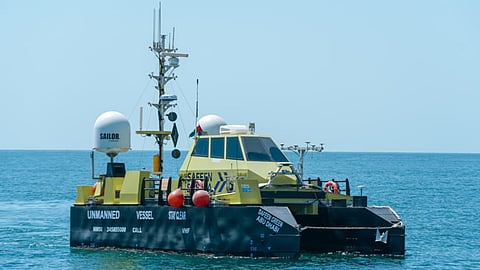
VESSEL REVIEW | Safeen Green – AD Ports Group's new unmanned craft to take on offshore inspection duties
UAE-based port operator AD Ports Group, via the Safeen Subsea joint venture formed with the NMDC Group, recently introduced a new unmanned surface vehicle (USV) that also features remote operating capability.
The 12- by six-metre (39- by 19.5-foot) Safeen Green will be used for marine surveys and inspection, maintenance and repair (IMR) in offshore waters. Classed as a marine autonomous robotic intervention platform (MARIP), it can operate up to 200 nautical miles from the coast and can collect high-quality geophysical and hydrographic data with minimal environmental impact.
The USV was developed to provide a cost-effective and safer alternative to traditional IMR activities on subsea pipelines utilising divers. Traditional commercial diving required extensive logistics, manpower and coordination across various teams, and it also put personnel at risk due to factors such as fatigue, intense underwater pressures, currents, low visibility, and adverse weather that can severely limit the amount of time a vessel and crew can spend out at sea.
The solution introduced by the MARIP was developed to reduce costs, enhance safety, and limit environmental impact, all while complying with regulatory and technical requirements.
The vessel was designed to be controlled over the horizon from an onshore remote operation centre, utilising advanced navigation and safety technologies, AI, 4G connectivity and data analytics to ensure continuous and secure operations as well as timely and accurate monitoring, data collection and dissemination.
The craft itself is made from lightweight, recyclable HDPE to help reduce its carbon footprint. The HDPE construction means there is no need for antifouling solutions that can potentially harm the surrounding marine environment.
Equipped for low-emission operations

Because IMR operations can now be performed using only one platform, there is no need for additional vessels, as is often the case during traditional diving activities. This alternative approach helps reduce vessel redundancy and mobilisation times.
Also, because fewer vessels and no embarked personnel are involved, there is a significantly reduced risk of human error, equipment failure, and accidents that could lead to injury or even loss of life.
The AD Ports Group said the USV will operate on either battery power or biofuel, allowing it to generate only 10 per cent of the emissions of a conventional vessel while limiting the probability of environmental incidents such as oil spills. The dual autopilots, redundant HD cameras with 360-degree monitoring capability, and comprehensive monitoring systems ensure secure and efficient operations.
The hybrid power setup consists of triple-redundant generators driving waterjets with batteries providing backup if the main generators fail. The propulsion can also guarantee continuous operation whether during maintenance or surveys, whereas manned platforms may sometimes need to temporarily suspend work due to fatigue and other factors impacting the crew.
The craft is also designed to accommodate modular payload options such as sonars, lidar, magnetometers, remotely operated vehicles (ROVs), and acoustic telemetry systems. A dynamic positioning (DP) system provides station-keeping capability even in harsh operating conditions while a FLIR camera provides enhanced low-light situational awareness.
The USV is fitted with a moonpool through which ROVs and underwater sensors can be deployed and recovered. The ROVs will be used to carry out the actual IMR work including cleaning of surfaces and repair of damaged sections.
The electronics suite includes Sailor communication equipment supplied by Xtra-Link as well as a Furuno NXT radar.
Easily deployable for urgent inspection and repair work
Safeen Green will be operated in conjunction with an autonomous underwater surface vessel. Route optimisation is possible thanks to advanced modeling tools that will calculate paths for the USV to take to ensure that surveys can be done more efficiently.
AD Ports said the vessel’s operational flexibility allows it to serve multiple sectors including oil and gas, offshore wind, and deep-sea mining. The USV is compact enough to fit inside a standard shipping container for global deployment.
The USV is being prepared to gradually take over traditional crewed dive support vessels (DSVs) in three phases. The USV will initially be used for inspections and non-critical maintenance before being tasked for more complex operations such as repairs. In the final phase, the USVs will be deployed on fully autonomous operations with the crewed DSVs serving only as backup.
For its initial test deployment, the USV was used to inspect a 24-inch subsea pipeline measuring approximately 100 kilometres (60 miles) long. The craft was also tasked with detecting anomalies such as damage with the aid of advanced imaging sensors.
The deployment took place in an area where high waves and strong currents were prevalent, resulting in limited visibility that would have prevented a traditional crewed vessel and divers from safely and effectively undertaking IMR work. Thanks to its DP system and its real-time data transmission capability, the USV allowed shoreside operators to closely monitor the conditions of the pipeline even as the vessel was being subjected to extreme sea conditions.
Safeen Green will initially be operated in support of Abu Dhabi National Oil Company, which has a network of more than 500 offshore structures spread out across 5,000 kilometres (3,000 miles) of subsea pipelines.
