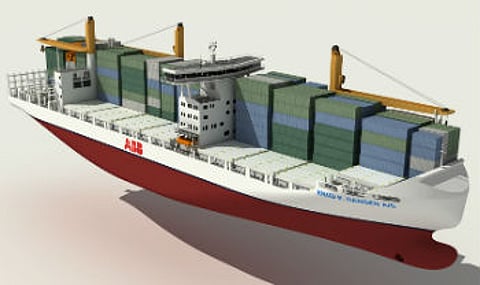
Knud E. Hansen and joint venture partner ABB have developed a new design for a 2,000TEU container feeder vessel. Dubbed Bangkok-max, the vessel's main dimensions have been optimised for calling in Bangkok.
The vessel was designed to deliver excellent fuel economy, reduced environmental impact, reduced need for water ballast, slow-steaming potential and flexible transit speeds, loading flexibility as well as increased container capacity including higher than usual reefer capacity.
Propulsion efficiency is boosted by an electrically driven counter rotating ABB Azipod unit, which is fitted behind the directly driven main propeller. The power balance between the main propeller and the Azipod is approximately 65/35 percent, and as the Azipod can be turned 360 degrees, the vessel will have high manoeuvrability, reducing or eliminating the need for tug assistance in port.

Compared to a vessel with a conventional diesel-direct propulsion system the main engine has been considerably down-sized, and with a correspondingly smaller propeller diameter in combination with a low shaft line, ballast water to submerge the propellers in light loaded conditions is generally not necessary. At 18 knots the main engine with its shaft generator will deliver the entire propulsion power including the electrical power for the Azipod unit, the hotel load and the reefer containers. Additional auxiliary power is only necessary if higher speeds (up to 21 knots) are required or if an exceptionally large number of reefer containers are carried.
Three auxiliary engines with a total electrical power output of approximately 8000kW are arranged in an auxiliary engine room, which is completely segregated from the main engine room. With the main engine stopped, the vessel is able to navigate with a speed of more than 13 knots on auxiliary power and the Azipod alone.
The vessel has an overall length of 172 metres and a beam of 30 metres. Deadweight at the Bangkok-max draught of 8.2 metres is approximately 18,300 tonnes, while it is approximately 28,400 tonnes at the fully loaded draught of 10.5 metres.
The midship position of the narrow deckhouse provides better vision from the bridge and allows approximately 15 percent more containers to be carried on deck than on conventional feeder vessels with the deckhouse located aft, while maintaining a crew comfort in bad weather.
Container capacity
Five tiers of high-cube containers can be stacked in the holds and six on the hatches. In the gearless version the vessel will carry up to 1,448TEU on deck and 668TEU in the holds corresponding to a total high-cube capacity of 2,116TEU.
As designed, the reefer capacity below deck is 438TEU, and with three tiers on the hatches and four on the aft deck the capacity on deck is 746TEU.
