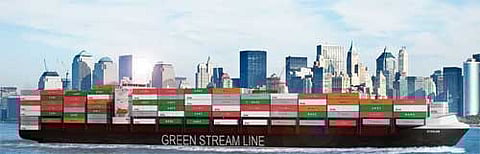

China makes use of German expertise
In April 2013 the Hamburg company TECHNOLOG sold licences to the SUMEC Marine Company of Nanjing, China, for the manufacture of the world's first family of LNG container ships.
The container ship family goes by the name of STREAM. It was developed by the engineering association IPP (Ingenieur Partner Pool) of Hamburg over a period of years, and has now been put on the market.
The new ship's design meets all future IMO requirements, making it possible for carbon dioxide emissions to be reduced by more than 30 per cent in comparison with the most recently delivered new ships of a similar size.
With the new container ships, SUMEC will be able to put container vessels with a capacity ranging from 3,500 to 5,000 TEUs on the global market. The ships will also measure up to the strictest international standards of environmental protection known to date. Not only can they show reduced carbon dioxide emissions, they also have a reduced output of nitric oxide (NOx) and sulphur oxide (SOx) gases.
All future IMO requirements already met
STREAM is an acronym, standing for Sustainable Transport, Reliable, Economic and AMbitious. The same design principle can be applied to many other categories of vessels. The hull form has been optimised with a view to the maximum payable container or project load, while keeping fuel consumption to a minimum. All vessels can be equipped with an innovative fuelling system, involving either fixed or mobile tanks or a combination.
The STREAM container ships offer a forward-looking and patented container storage system without hatch covers. The stopper element that comes with it absorbs the weight of the upper container layers, so that the pressure on the lower containers does not become excessive and cause container collapse. This means that container tiers can be piled twice as high as in the past, even without the help of cell guides.
The system makes it possible for standard 20 or 40 foot containers to be loaded or unloaded one stack at a time, and containers of abnormal width or length (including 45, 48 and 49 foot units) can be handled with equal ease. This avoids the expense of cargo relocation when in harbour, and so shortens the length of a ship's stay in port. Thanks to a special ventilation system, nearly all 40-foot slots in the hold and up to three layers on deck can be used to stow refrigerated containers.
With its dual fuel main engine, the ship can run either on traditional heavy fuel oil (HFO) or LNG. When LNG is used exclusively, sulphur oxide emissions can be almost completely eliminated. As a result the new ship's design already meets all future emission requirements of the International Maritime Organisation, and it also comes well below the mandatory limiting values for the emission of nitric oxides and sulphur oxides.
30 to 40 per cent fuel cost savings in marine operations
All the ship's mechanical systems have been coordinated to result in significantly reduced fuel consumption. The main engine not only generates the necessary propulsion power – it also provides all the electricity that is needed on board. A waste heat recovery system (WHRS), meanwhile, obtains additional energy from the exhaust, resulting in an even higher degree of efficiency. The propulsion system on board has been optimised for economical operation at speeds ranging from 14 to 18 knots, but at the same time it allows for catch-up speeds of up to 21 knots or more.
Depending on the type and size of vessels, fuel savings will be between 30 and 40 per cent in comparison with the most recently delivered new ships of a similar category. Compared with a 'conventional' new ship, a STREAM container vessel with a capacity of 5,000 TEUs will be able to save well over 500,000 tonnes of CO2 emissions in the course of its lifecycle.
