
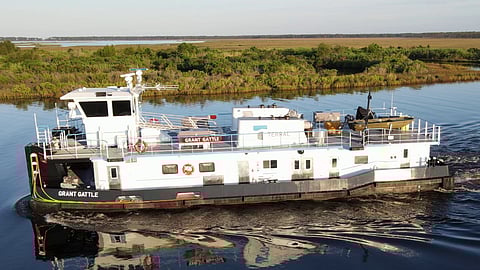
VESSEL REVIEW | Miss Charlotte Gattle & Grant Gattle – Terral RiverService to operate barge handling pusher tugs in southern US inland routes
Louisiana operator Terral RiverService (TRS) recently took delivery of two new inland tugs in a series built by Steiner Shipyard of Bayou La Batre, Alabama.
Miss Charlotte Gattle and Grant Gattle were designed by Farrell and Norton Naval Architects. The tugs’ areas of operations include the Gulf Intracoastal Waterway as well as the Atchafalaya and Red Rivers in Louisiana, where they will handle non-self-propelled barges laden with cargo.
The tugs are of all-steel construction to ensure durability for heavy-duty use in rivers while wrap-around fendering provides added protection during towing and berthing.
Heavy duty propulsion for daily use in inland waters

Each tug has a length of 88 feet (27 metres), a beam of 36 feet (11 metres), a draught of only 8.5 feet (2.6 metres), a depth of 9.5 feet (2.9 metres), and space for six crewmembers.
Three Mitsubishi S6R2-Y3MPTAW-3 diesel engines that each produce 800 hp (600 kW) at 1,400 rpm drive three Sound fixed-pitch propellers via Twin Disc MGX-5321DC gearboxes.
The TRS vessels also boast retractable wheelhouses to permit safe passage underneath bridges. The wheelhouse lift systems are from Gulf Coast Air and Hydraulic while the steering systems were supplied by Custom Hydraulic Components.
Each tug’s Furuno radars and other electronics draw power from two John Deere 99kW generators.
The tugs each have tank capacities of 34,400 gallons (130,000 litres) for fuel oil, 1,650 gallons (6,250 litres) for lube oil, 1,500 gallons (5,700 litres) for waste oil, 200 gallons (800 litres) for gear oil, 10,600 gallons (40,100 litres) for potable water, 11,600 gallons (43,900 litres) for wash water, and 200 gallons for hydraulic oil.
The spacious aft deck can also accommodate a small tender.
Maximised use of space for improved operability
“The vessels’ lines and production were among the biggest challenges in the design work,” Tom Farrell, Naval Architect at Farrell and Norton, told Baird Maritime. “The vessels were designed with extensive shape to the propeller tunnels, bilges and bow and stern rakes. The structure had to be designed and nested to be able to build in the shape.
“Since the boats had retractable pilothouses, the space on each boat was limited. We therefore worked extensively to use all the space efficiently.”
The TRS tugs also each have four cabins that provide comfortable accommodation in between shifts. The other facilities include three full bathrooms, two toilets, a galley, and a lounge.
