VESSEL REVIEW | Deirdre Ann – Versatile pusher tug delivered to Maritime Partners
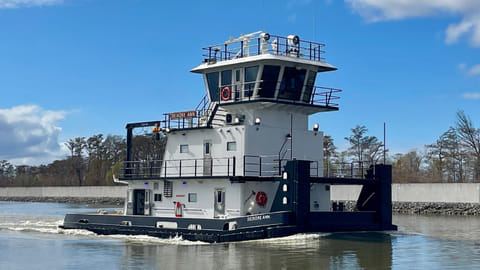
US marine transportation company Maritime Partners has taken delivery of a new inland pusher tug built by FMT Shipyard and Repair of Harvey, Louisiana.
As with other pusher tugs in the Maritime Partners fleet, Deirdre Ann will be used for the handling of barges that transport a broad range of dry and liquid bulk cargo such as petroleum products, chemicals, grain and aggregates.
The newbuild has a length of 52.5 feet (16 metres), a beam of 19.6 feet (5.97 metres), and a draught of only 3.3 feet (one metre), enabling access to a greater number of inland ports.
Propulsion arrangement optimised for heavy duty use
Utilising a standard US inland pusher tug design, Deirdre Ann has her wheelhouse mounted high above the main deck to provide the crew with excellent all-round visibility even when handling multiple barges simultaneously.
The vessel is powered by two Mitsubishi S6R2 US EPA Tier III engines, each with a rated output of 803 hp (600 kW) at 1,400 rpm, with commissioning support from Laborde Products.
The engines drive two propellers and are configured for maintaining steady power over extended periods instead of attaining high transit speeds during brief periods. The machinery compartments have meanwhile been laid out to ensure ease of access, servicing, and maintenance to help minimise downtimes.
Part of an ongoing fleet modernisation program
Deirdre Ann was handed over to Maritime Partners in early 2026 as part of the company's fleet renewal program. Beth Williams, another pusher tug from the same series, was introduced into service at around that same time.
Although belonging to a different series from their predecessors in the Maritime Partners fleet, the newer vessels’ near-identical specifications will help ensure that the owner’s operations become more streamlined with regard to crew familiarisation/training and vessel maintenance. In particular, navigation and maintenance teams already familiar with the owner’s existing vessels would require only minimal additional training in handling and servicing the new platforms.
