
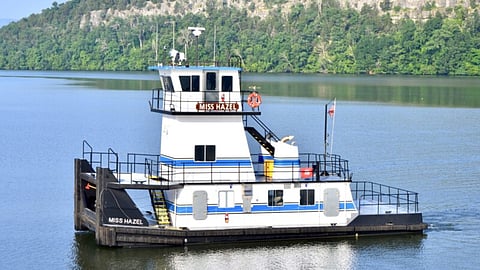
VESSEL REVIEW | Chipper Rabbit – Parker Towing adds heavy duty inland pusher tug to fleet
Tennessee-based shipbuilder Serodino has handed over a new inland pusher tug to Parker Towing Company of Northport, Alabama.
The vessel has been named Chipper Rabbit in honour of Parker Towing’s Vice President of Finance and Chief Finance Officer, who has been with the company since 1997. Another inland pusher tug from the same series is also in operation with Parker Towing.
Chipper Rabbit has a length of 60 feet (18 metres), a beam of 24 feet (7.3 metres), a draught of only 5.5 feet (1.7 metres), and a depth of eight feet (2.4 metres). The tug is constructed of half-inch steel plate throughout with half-inch plate over the wheels and on the bilge knuckles.
Enhanced visibility coupled with significant pushing and pulling power

The vessel utilises the standard modern pusher tug design of a wheelhouse placed high enough above the main deck to provide unobstructed visibility ahead and astern for the bridge crew even when handling multiple barges.
The tug is powered by two Mitsubishi S6R-Y3 US EPA Tier III main engines that each produce 684 hp (510 kW) at 1,800 rpm and drive propellers via Twin Disc MGX5222DC gearboxes.
Laborde Products, which supplied the main engines, said that the propulsion package was selected to support the vessel's operating profile while providing a dependable platform for day-to-day operations.
The propulsion machinery also includes a John Deere 4045FM75A auxiliary engine, which drives a 40kW generator.
Follow-up lever controls in the wheelhouse separately activate four flanking and two main rudders. The hydraulic pumps are driven by electric motors.
The inside engine mounts are continued fore and aft as solid sheets to divide the hull into three collision compartments, three fuel tanks with a total capacity of 8,000 gallons (30,000 litres), an engine room, three freshwater tanks, and six stern compartments. A 110-gallon (420-litre) lube oil tank and a 120-gallon (450-litre) transmission oil tank have been built into the hull.
Interiors laid out for improved comfort during operations for sustained periods
Standard equipment includes navigation lights, one incandescent and one Xenon searchlight, Wintech electric winches, Schuyler rubber push knees, perimeter fenders, a shore power plug-in system, and Fernstrum coolers.
The superstructure is constructed of 3/16-inch plate. The doors are made of steel and the windows are aluminium with safety glass panes. All crew cabins are insulated, aluminium-panelled, heated and air-conditioned by a Mitsubishi climate control system, and have rubber floor coverings.
The main deck facilities include a storage room, a galley, a toilet with shower, and a US Coast Guard-approved marine toilet. The second deck meanwhile features a locker. All decks are coated with non-skid surfaces.
The electronics include a Furuno radar, Standard Horizon radios, alarms from Honeywell and Eagle Control Systems, an SI-TEX AIS, and a Radio Zeeland swing meter.
