
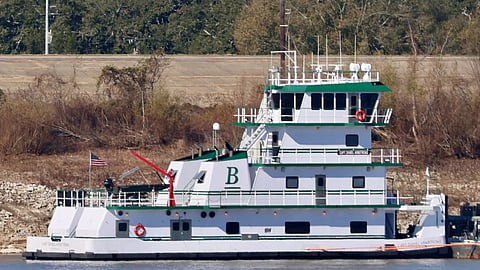
VESSEL REVIEW | Capt Daniel Armstrong – Blessey Marine Services welcomes EPA Tier IV inland tug to fleet
Blessey Marine Services, a marine transportation company based in New Orleans, has taken delivery of a new inland pusher tug built by Vessel Repair (VRI) of Port Arthur, Texas.
Capt Daniel Armstrong is the first US EPA Tier IV-compliant vessel to join the Blessey Marine fleet as well as the fourth vessel to be ordered by the company from VRI.
The tug honours Daniel Armstrong, who has worked with Blessey Marine since 1999, starting out as a tankerman and eventually becoming a pilot and lead captain.
“The vessel utilises a patented combination single chine with double chine hull to increase towing and fuel efficiency,” Ron Fogan, Director Boat Maintenance at Blessey Marine, told Baird Maritime. “Additionally, she has patented asymmetrical flanking rudders to further increase towing and fuel efficiency. The vessel is fitted with an outward taper of the lower inboard side of the push knees to relieve buildup of bow water.”
New features include a duct system for the intake air from fo’c’sle deck down and under the water tank into the engine room at floor-plate level, which increases efficiency by providing cooler air in the engine room. To protect the crew from the elements, the vessel is designed with a forward passage connecting the lower engine room to the forward hold.
“For Blessey Marine, the vessel provides a modern, more efficient vessel with higher horsepower for our fleet,” added Fogan.
Propulsion setup optimised for heavy-duty daily use

Capt Daniel Armstrong has a length of 84.5 feet (25.8 metres), a beam of 32 feet (9.8 metres), a depth of 11 feet (3.4 metres), and two Mitsubishi S12R-Y4MPTAW-3 diesel engines that each produce 1,260 hp (940 kW). The engines drive Baumann four-bladed propellers via Reintjes WAF 665L gearboxes. The propellers were supplied by Karl Senner.
The propulsion machinery also includes an electric-hydraulic steering system from Custom Hydraulics. Christie and Gray provided the engine isolators to help reduce noise and vibration while Hiller supplied the fire suppression system.
Tank capacities are 15,077 gallons (57,073 litres), 377 gallons (1,430 litres), 3,105 gallons (11,750 litres) and 1,571 gallons (5,947 litres) for fuel oil, lube oil, potable water and diesel exhaust fluid, respectively.
Ergonomic layout coupled with enhanced safety features
“The potable water tank on the vessel is of 316 stainless steel to create a purer and maintenance free water supply,” said Fogan. “The wheelhouse windows forward are all full length, including an aft centerline window. There is also an extra large forward hold with plenty of storage shelving and a work bench.”
The deck equipment consists of a Schoellhorn-Albrecht capstan and two Patterson Manufacturing 40-ton winches while the electronics include Raymarine Pathfinder radars (the first installation of such radars on an inland vessel, according to Fogan), a class A AIS, depth sounder and satellite compass from Furuno, three Standard Horizon VHF radios, an Intellian satellite TV system, a JRC swing meter, and a Sim Vue engine alarm.
These and all the other onboard systems draw power from two John Deere 4045AFM85 99kW generators.
“The generator room is outfitted with double exterior doors to eliminate the danger of down-flooding into the main engine room,” Fogan added.
The crew accommodation includes five cabins, a lounge with a dining area, and three toilets with showers. The lounge and dining area feature a six-foot (1.8-metre) wide observation window with a four-foot (1.2-metre) wide window above the galley sink.
“All machinery piping and hand rails are stainless except the hydraulic and cooling piping,” Fogan told Baird Maritime. “Also, there are no stacked bunks in the staterooms to eliminate potential safety concerns.”
The other key equipment includes a Seahorse wastewater treatment system, DuraWeld keel coolers, Rivertough bearings, Thordon Bearing shaft seals, and M&M Bumper Service fendering.
Capt Daniel Armstrong currently operates along the Mississippi River from New Orleans to Chicago.
