
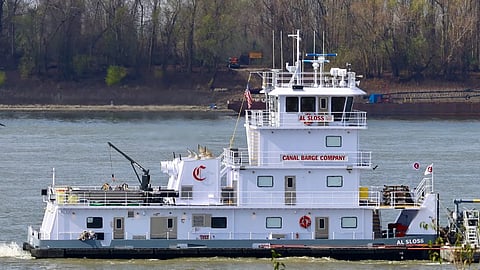
VESSEL REVIEW | Al Sloss – Canal Barge Company acquires first unit in new series of inland pusher tugs
New Orleans-based Canal Barge Company has taken delivery of the first vessel in a new series of four inland pusher tugs designed and built by C&C Marine and Repair.
Al Sloss is the first vessel in a new series of pusher tugs ordered by Canal Barge from the same builder.
“One of the most interesting elements is that this project marked C&C’s first construction integrating a full diesel exhaust fluid (DEF) system—a direct outcome of the vessel’s EPA Tier IV compliance path—and it required careful integration into the overall machinery and tankage arrangement,” the builder told Baird Maritime.
“From a crew-and-operations standpoint, the vessel is also laid out as a purpose-built inland pushboat with accommodation for eight, and the specifications emphasise practical operator details such as pilothouse visibility considerations and systems organisation that support day-to-day towing work.”
C&C said the brief was to deliver an all-welded steel, diesel-powered, twin-screw tug purpose-built for push towing on inland rivers, canals, and intracoastal waterways, built with compliance in mind and with messing/berthing for a crew of eight. Duties include pushing barge tows, shifting barges, and supporting inland logistics movements consistent with the owner’s operations.
The design and onboard capacity, particularly the accommodation for eight and the consumables capacity sized for inland work, will support sustained operations and typical towboat duty cycles.
Part of fleet standardisation efforts
“In the context of the series program, the owner’s requirements also included building a repeatable platform – Al Sloss as the first boat set the standard – while maintaining close collaboration during construction so that minor adjustments could be incorporated without losing momentum. In other words, it wasn’t just ‘build to spec’, but ‘build to spec with an engaged owner and an efficient, series-minded approach’.”
C&C explained that Al Sloss filled the owner’s need for new, standardised capacity as the first unit of a four-boat series, bringing a high total installed power and a repeatable platform into service as part of a fleet upgrade program.
With EPA Tier IV compliance incorporated in the propulsion architecture, the vessel will also support the owner’s requirements for operating a contemporary inland tug that aligns with current emissions expectations while maintaining the operational fundamentals of a platform designed for real-world tow handling.
The newbuild has a length of 87 feet (27 metres), a beam of 34 feet (10 metres), a depth of 11.3 feet (3.44 metres), and two Mitsubishi S12-R main engines that each produce 1,300 hp (970 kW). The engines drive two propellers via Reintjes WAF 665 gearboxes, thus forming a drivetrain designed for steady performance in continuous-duty inland towing service.
Outfitted for improved emission control

“The Tier IV compliance arrangement includes SCR/aftertreatment integrated into the stacks, and the overall machinery package is supported by a closed grid-cooler cooling approach, driveline components sized for inland duty, and an integrated steering/alarm/monitoring architecture,” C&C told Baird Maritime.
“In addition, the project incorporated a full DEF system, which is a key enabler of the Tier IV path and required thoughtful tankage, piping, and operational-access planning.”
The builder remarked that the standout element is the Tier IV architecture itself – particularly the integration of the aftertreatment/SCR in the stack arrangement – paired with the onboard DEF system that supports emissions compliance.
“From an inland operator standpoint, the cooling and propulsion choices are also engineered around reliability and serviceability in river conditions, which is often the real differentiator in towboat performance over time.”
Also fitted are two FPT 99kW generators to supply power for the various onboard systems.
The electronics and navigation suite is built around a Furuno radar/AIS and multi-station communications package, including dual FAR1518 12kW radars with open-array antennas and dedicated HD monitors, an FA170 AIS, an SC-70 GPS gyro heading compass, depth equipment and displays, and a hailer/intercom system with multiple stations.
The communications equipment includes multiple fixed VHFs with antenna/speaker provisions and portable VHFs, along with connectivity provisions such as a marine cell antenna and an Intellian satellite antenna.
Proven deck machinery and electronics coupled with ease of operation
“What stands out is the emphasis on maintainability and system organisation,” said C&C. “The specs include practical features like hinged radar masts for easier maintenance and a structured approach to onboard networking with defined Cat6 cabling runs and terminations from an electronics space to key areas of the vessel. That ‘build it to be supported and upgraded’ mindset is increasingly important for inland operators.”
The deck equipment package includes two Wintech 40-ton winches, a Wintech five-ton vertical capstan, and two Carlisle and Finch 1,000W searchlights, providing what C&C said is a heavy duty handling and visibility setup appropriate for inland tow work.
“The vessel’s structure and outfitting approach also reflect pushboat realities, with towing knees and robust fendering called out to support the loads and contact points inherent to pushing service.”
C&C said the interesting aspect of the deck equipment is the disciplined, work-first selection and integration. The gear itself is proven and appropriately sized, but the specifications emphasise robust foundations and structural support under deck fittings and major machinery so the tug can take repeated line loads and operational impacts without permanent distortion.
“This is exactly the kind of detail that matters to operators and port engineers because it shows up in longevity and reduced maintenance,” the builder remarked.
The interiors meanwhile feature a soft-core joiner system in the accommodation spaces for improved comfort and fire protection, and the specifications detail safety/alarm and fire detection/suppression elements aligned with inland operational expectations.
“Taken together with the series-build efficiency gains – where the boats remain largely consistent from boat one through boat four but become faster and more efficient to deliver – the overall program shows a mature approach to building repeatable, operator-focused inland tonnage,” said C&C.
The builder said the most significant design challenge was the systems integration required by a Tier IV propulsion and emissions-compliance approach – specifically packaging the aftertreatment/SCR and integrating the associated DEF system into a compact, serviceable inland towboat arrangement while preserving maintainability and crew-centric layout priorities.
“At the same time, the design needed to support practical pilothouse ergonomics and sightlines for push operations, plus a workable multi-deck arrangement that meets the vessel’s operational and accommodation requirements,” C&C told Baird Maritime.
“From a production perspective, the challenge was executing a high-quality newbuild while also setting the cadence for a four-boat series. Boat one is where the team proves the build plan, the vendor coordination, and the installation sequence.”
C&C said a second challenge was navigating the market conditions around equipment/material sourcing that were top-of-mind at the time. Even though tariff-related uncertainty prevails, the company’s engineers have emphasised that impacts were ultimately minimal due to planning and vendor coordination, and so the challenge was more about risk management than about disruption.
Efficiency improvements as more vessels are built
“Finally, building in the DEF system for the first time at C&C added new installation and commissioning considerations, especially because it sits at the intersection of emissions compliance, consumables management, and operational reliability.”
For the builder, the biggest takeaway is that the series-build approach has compounded benefits. While there were no major changes from boat one through boat four, the repetitive nature of the program enabled the yard to refine installation sequences, reduce rework, and drive greater schedule efficiency with each hull that follows.
“On the technical side, integrating the DEF system for the first time created a knowledge base that carries forward – covering design allowances, installation best practices, and commissioning lessons that reduce risk and time on future Tier IV projects,” C&C told Baird Maritime. “From a project-control standpoint, the experience reinforced that early, proactive vendor coordination can keep external cost/supply volatility from becoming a schedule problem.”
Construction of Al Sloss lasted approximately six months. The remaining tugs in the series are scheduled to be delivered to Canal Barge at intervals of two to three months.
