
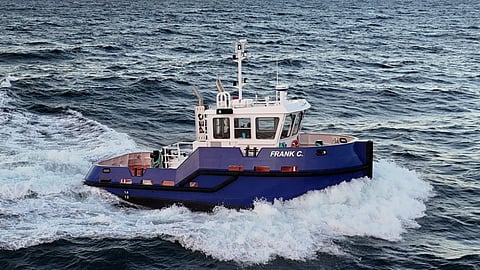
VESSEL REVIEW | Frank C – Canadian operator's new compact tug to support dredging and construction projects
Les Entreprises PEC, a civil engineering company located in Bonaventure, Quebec, has taken delivery of a new compact tug constructed by Canadian shipbuilder Chantier Naval Forillon (CNF) at its Rivière-au-Renard facilities.
Frank C was designed by local naval architecture firm Navanex. The custom-built, under 15GT tug is named in honour of François Cayouette, the founder of PEC.
“The vessel marks the return of full newbuild ship construction to Rivière-au-Renard,” CNF told Baird Maritime. “Her optimised hull and high installed power provide exceptional performance in confined and shallow-water environments.”
Small size and shallow draught ensuring suitability for remote ports

The builder added that the owner required a small but highly powerful tug capable of supporting port operations, marine construction operations, dredging support, and coastal towing. Key requirements included a shallow draught, excellent manoeuvrability, reliability, and enough power to operate safely at smaller ports along the Quebec coast and in the Gulf of St Lawrence.
“Frank C fills the need for a compact yet powerful tug that can operate efficiently in shallow and restricted port environments while still offering coastal capability. It significantly enhances operational flexibility for the owner.”
The tug has a length of 11.95 metres (39.21 feet), a beam of 4.45 metres (14.6 feet), and two Caterpillar C9.3 diesel engines that each produce 375 hp (280 kW).
Each engine is coupled to a Twin Disc MG5114SC HD marine gearbox, and CNF said this twin-engine configuration provides redundancy, excellent low-speed control, and strong towing capability. This setup delivers high torque and responsiveness while remaining within sub-15 GT constraints.
“Despite her compact size, Frank C boasts a small mess, providing basic comfort for her crew during operations,” added CNF.
The wheelhouse electronics meanwhile include a Furuno radar. The wheelhouse itself features reverse-angled windscreens to help reduce glare and minimise the use of wipers when operating under adverse weather conditions.
Design challenges overcome through early integration and close coordination with the owner
For CNF, the main challenge in designing and building the tug was in integrating a high-power, twin-engine propulsion system within a compact hull while maintaining stability, weight balance and ease of maintenance.
“The project was also executed on an aggressive schedule, requiring tight coordination between design, production engineering, and construction,” the builder told Baird Maritime.
“Even so, the work on Frank C reinforced the importance of early integration between design and production engineering, precise weight control, and close collaboration with the owner. This approach enabled rapid execution while maintaining build quality and regulatory compliance.”
