

Gard P&I Club are in the process of publishing a series of insight articles about heavy weather. Written by Mark Russell, they are full of good advice and well worth reading.
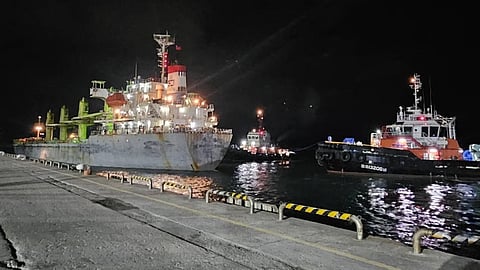
The second installment, published last week, concentrated on heavy weather when ships are in port or in the process of departing, so tugs feature prominently.
Mr Russell kicked off with a section on mooring failures that also included a number of case studies. We learn of cruise passengers falling off a gangway when their ship broke away from the berth, and there are other sections that consider mooring line failure, berth infrastructure failure and shore bollard failure.
He pointed out that ships can take extra measures when heavy weather is expected, but, “if conditions are worse than forecast and parted lines in the water prevent use of ship’s power, it may be too late for tugs to save the day.”
To demonstrate this, he cited three cases: a car carrier where tugs arrived 23 minutes after they were requested and eight minutes after the first line parted; a bulk carrier where tugs arrived 22 minutes after they were requested and 25 minutes after the first line parted; and a drill ship where tugs arrived 15 minutes after they were requested and 15 minutes after the first line parted.
He concluded by saying that, “prudent overreaction may have seen tugs arriving earlier in these and other cases.”
Finally, Mr Russell considered heavy rains affecting river berths, and he cited a couple of cases on the Brisbane River. He failed to mention the fact that, in both Brisbane cases, tugs arrived in time to save the day – not the first time tugs in Brisbane have pulled victory from the jaws of defeat, of course.
So, what can tug folk learn from these studies?
First, I would suggest that response times of 23, 22 and 15 minutes are not bad at all. No doubt it seemed like much longer to the people on the ships involved, and it is true that “prudent overreaction” would have seen the tugs arriving in a more timely manner.
But we all know that seafarers are reluctant to spend money (if they are even permitted to make decisions for themselves), so it is rare that a ship will order tugs before it becomes obvious that they will be needed. Effectively, we live in a world where tugs are unlikely to be ordered before it is too late.
Perhaps the answer is for tug companies to become more proactive.
With the vast amount of local knowledge possessed by tug companies, it is perfectly possible to work out when and where tugs might be needed in bad weather.
In Hong Kong, I generally had a tug patrolling the harbour during typhoons. Slow steaming did not burn a great deal of fuel, and it meant we might have a tug close by if a ship got into trouble, at which time we could charge extra for an emergency response.
The potential benefits outweighed the cost, and an added advantage was that I could get real-time information on the actual weather conditions in various corners of the port.
In better weather, we also had a policy of not returning all our tugs to base when the container port was quiet. One or two would be left tied up in quiet corners in case there was an emergency – a policy that saved 15 or 20 minutes mobilisation time and could mean the difference between sorting out a problem and seeing it become much worse.
Tactics such as the ones I describe are not too difficult to work out, and I suspect there are many companies in many ports that do something similar. If not, why not?
Sometimes, the need to adapt to unfavourable conditions may be forced upon the tug companies by unexpected events, and in Hong Kong, we were victims of gentrification.
When I first visited the port in the early 1970s, the tugs were based in the harbour and located close to the proposed site of the new container terminals. Sadly, as the population increased, the city expanded in all directions and residents who had paid a lot of money for harbourfront homes started complaining about the noisy, smelly tugs on their doorsteps.
At the same time, reclamation removed many of the places we considered suitable for tugs to lurk between jobs.
Over the years, tugs and other harbour support services were forced to move further from the central harbour areas, and response times became much greater. This process continues, and the local tug companies are probably already thinking up new strategies.
People say Hong Kong will be nice when it is finished, but there is no sign of it being finished any time soon.
Another consideration is how often a particular port is likely to be affected by adverse weather. My arrival at a Hong Kong tug company coincided with a period when every typhoon seemed to avoid us. For many years, we went through the motions of preparing for typhoons that recurved before they reached us, or wandered off in unhelpful directions, so, whilst our seagoing tugs were busy, the harbour was generally like a millpond.
Shortly after I retired, the typhoons returned. The experts blamed global warming, but my former colleagues had no doubt their fortunes improved when Jonah departed. Probably not something you can plan for!
