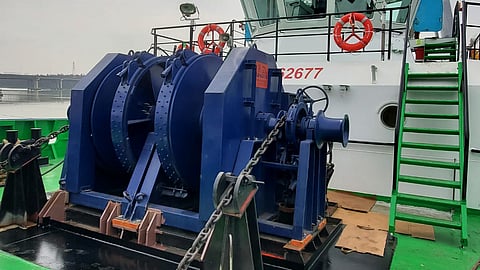


A recent article in International Tug and Salvage caught my eye. Written by Martyn Wingrove, it centred on an interview with Cem Huroglu, who is sales and marketing director of a company called Data Hidrolik.
The article claimed tugs need to be designed with integrated deck machinery that is durable, sustainable, and smart. This is why Data Hidrolik has turned its research and development focus towards implementing digital and emissions-reduction technologies for its deck machinery and providing integrated operational systems.
"The company’s next-generation electric windlass and winches will be part of a towage system designed for low-emissions operations," said Mr Huroglu. "They will have technology enabling remote monitoring and digital integrations that ensure data traceability and enable predictive maintenance. The deck of a modern tugboat (sic) is not just a collection of individual equipment, but a total of systems working in perfect harmony."
There is more, but I am sure you get the drift, and this is just one of many articles appearing at the moment that tell us how technology will make our lives simpler and better.
Such technology will never be used to reduce manning levels or crew competence, of course, but will inevitably lead us into a future of broad, sunlit uplands where capable professionals can sit drinking gin and tonic whilst the machines do the work for them.
What disappoints me is that these people are never subject to rigorous cross examination, but are permitted to say whatever they like without interrogation.
CHIRP Maritime, the excellent charity that publishes reports from seafarers about accidents and near misses, often reminds shipping people to speak up when they see something going wrong, and they are always urging companies to encourage their people to do so.
However, it is not always easy for a junior person to tell the captain or chief engineer they are about to stray from the paths of righteousness. Perhaps it is the same for reporters, and perhaps that is why so many of the claims made by the technology and software companies are allowed to go unchallenged.
At least people in our industry will eventually know how many accidents are caused by technology and software malfunctions and, dare I suggest, we may already be seeing the first signs of the perils to come.
The new edition of CHIRP Maritime’s excellent Feedback magazine will shortly be published on their website, and it features a report about a large superyacht that was attempting to enter and berth in a particularly tricky harbour when it suffered a partial blackout that almost led to a serious accident.
Several critical systems went offline, navigation systems rebooted, and engine room monitoring screens went dark. Emergency power was restored to a limited extent, and despite the confusion, the crew managed to berth the yacht before it did any damage to nearby vessels or the port’s infrastructure.
Investigation by technical crews eventually traced the failure to a remote software update on a galley refrigeration unit. Please do not ask me why the galley fridge even needs a software update when galley fridges have worked perfectly well for generations without software updates, but such were the facts.
It was also discovered that the update had been pushed by the supplier of the equipment without notifying the vessel. During the update, an electrical load spike triggered the vessel’s power management system to start shedding systems in a sequence that the crew (and everybody else, I suspect) did not fully understand.
As CHIRP Maritime commented, the incident highlighted the risks of remote software updates being pushed to vessels without prior communication. In this case, a non-essential system – the galley refrigeration unit – indirectly affected essential navigation and monitoring systems through the integrated power management arrangements.
CHIRP also highlighted the potential cybersecurity implications. If an innocent update can gain access and cause such mayhem, imagine what a malicious cyber attack could accomplish!
The thought of a tug operating under the bow of a large vessel when some lunatic ashore decides to send an update for the tugger winch or galley fridge software is quite alarming, so I hope readers will ensure that software updates are controlled by the tug, not by the software developers or even by management.
I am sure that Mr Huroglu and all the other software developers are driven by a genuine desire to make our lives easier and more efficient, and their intentions are honourable, but it was a very wise man who reminded us that the road to hell is paved with good intentions.
Finally, I am reminded that we are about to celebrate Chinese New Year, so Kung Hei Fat Choi (or Gong Xi Fa Cai, if you prefer the Mandarin greeting) to you all, and may the Year of the Horse bring you good fortune and great happiness.
