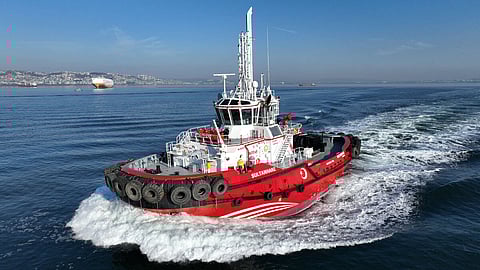

This state-of-the-art harbour tug supports towing, escort, and ship assist duties in the busy waters of oil and gas hub Ceyhan in Turkey.
Powered by two 3,000kW dual-fuel engines, it can operate on either diesel or LNG, making it one of the first such tugs in operation in Turkey and among the few LNG-powered tugs worldwide. This system enables significantly reduced emissions, even on diesel alone, thanks to an IMO Tier III aftertreatment installation.
The Robert Allan Ltd (RAL) design strategically places the LNG tank hold aft of the engine room to separate gas systems and hazardous areas from the accommodation block, enhancing crew safety.

"Sulthanhani is the first vessel in the world to combine a Voith tractor tug design with dual-fuel LNG and diesel propulsion," Andra Papuc, the project manager at RAL for the vessel, told Baird Maritime.
"The state-of-the-art propulsion arrangement allows Sulthanhani to confidently undertake challenging escort operations as VSPs are well-known for their fast response time and safe and precise manoeuvring."
This tug also features a new design for the VSP guard plate, which optimises bollard pull performance and simplifies construction. The dual fuel engine meanwhile allows for seamless transition between LNG and diesel.
"Additionally, the tug is fitted with an exhaust aftertreatment arrangement consisting of SCR units, mixing tubes, and a dedicated diesel exhaust fluid system, which allows the tug to maintain IMO Tier III emission compliance even in diesel operating mode."
The 40-cubic-metre LNG tank is fitted aft of the engine room in a dedicated compartment and is installed transversely allowing for a more compact and efficient arrangement. This arrangement also separated LNG hazardous zones from the accommodation block forward.
The design work posed challenges, particularly in the integration of LNG fuel storage while still ensuring adequate space for the propulsion setup.
"Fitting the LNG tank in the same design as a Voith Schneider propulsion package was a challenge, as both can take up a considerable amount of space," said Papuc. "This is why orienting the LNG tank transversely was necessary.
"In doing so, however, the stern of the tug became fuller than usual in order to maintain the required clearance between the LNG tank and hull shape. This then raised concerns about the tug’s directional stability when sailing bow first.
An extensive computational fluid dynamics (CFD) program was completed in-house to analyse and optimise the tug’s directional stability characteristics, and eventually the design was fitted with RAL's strake stabilisers at the stern.
Papuc said this design feature yielded very positive results on sea trials, while a model test program during the vessel design phase also confirmed the results of the CFD analyses.
"Arranging the LNG outlets and inlets to minimise the extent of hazardous zones and their effect on the remainder of the arrangement was also a challenge," Papuc told Baird Maritime.
"A carefully designed force ventilated LNG vent mast allows possible vented natural gas from the LNG tank and system to be well dispersed on exit, without the potential for cold vapour collapse. The vent mast locates the outlet well above the working deck and away from any crew areas or ventilation intakes."
For a list of the 2025 "Best Of" award winners, please click here.

