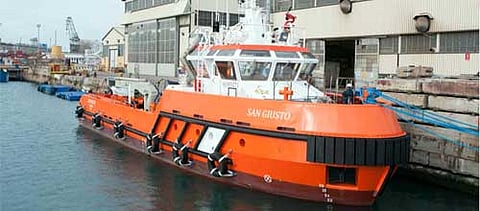

Trieste-based shipyard Nuovo Arsenale Cartubi has recently delivered the terminal support/escort tug 'San Giusto' to Italy's SIOT terminal.
Classified by RINA, the vessel measures 28.5 metres in length overall, with a beam of 7.5 metres and a depth of 3.3 metres. Designed and outfitted to perform a wide range of tasks, capabilities of the vessel include ship handling and escort duties, fire fighting operations, and oil recovery.

On board, the vessel has been outfitted with an advanced range of equipment, as well as amenities for six crew and seating for up to 12 passengers. The wheelhouse is designed for maximum all-round visibility, with a single control station overlooking both the fore and aft deck working areas. The vessel's aft deck has been arranged to facilitate oil recovery operations, including the launch and recovery of a small anti-pollution vessel via a three-tonne crane.
Propulsion includes a pair of Caterpillar C32 main engines, each rated at 895kW and driving fixed-pitch propellers in Kort nozzles. Auxiliary power, meanwhile, is provided by a pair of Caterpillar generators, each rated for 35kW. The vessel's free running speed is 13 knots and she has a bollard pull of 25 tonnes.
Under management by vessel operator Ocean, the vessel is currently performing operations at Società Italiana per l'Oleodotto Transalpino (SIOT) crude-oil-terminal, located at the Muggia bay in the Trieste Gulf. SIOT is the gateway terminal to the Transalpine onshore pipeline. The pipeline is over 450 kilometres long and runs through Italy, Germany and Austria. Last year, the Trieste terminal was visited by over 400 oil tankers, supplying a total of 35 million tonnes of crude oil to the pipeline.
Italy's SIOT terminal
The 'San Giusto' is on permanent duty supporting the SIOT terminal and the Transalpine project. She will remain on constant standby in the area, ready to respond to emergency operations such as accidental emissions or spillages.
Stefano Fermi
