Ro-Ros are popular within the European trade routes. The Ro-Ro fleet allows for carrying out intermodal transportation from any point in western Europe to eastern Europe and the Middle East at the highest optimisation level of the transport procedure, low prices and in a comparatively short time.
The Port of Rotterdam
The Port of Rotterdam offers freight forwarders and hauliers a wide selection of Ro-Ro transport. Five different ferry operators each have their own specialities and destinations. Common to these are the excellent accessibility from the hinterland, the open connection with the North Sea, the short sailing distance to and from many ports in the UK and the guaranteed departure and arrival times.
On board in the evening means delivery to the destination in the morning and vice versa. It is for good reason that Rotterdam is the number one Ro-Ro port in the northwest European Hamburg – Le Havre range.
Although the Ro-Ro sector is considerable as compared with other ports, the Port of Rotterdam does not have very much information on it. One of the reasons is that Cobelfret, as a private company, is rather "closed"; such is also the case with Norfolkline, as long as it comes under the Maersk family. DFDS Tor Line is in an intermediate position while the most open is Stena Line.
Ro-Ro traffic in Rotterdam has been showing steady growth for years. Expectations for the coming years are also positive. Several Ro-Ro operators have responded to this by expanding their own terminals.
However, due to the global financial crisis, provisional figures from the Port of Rotterdam Authority show that container volumes fell by six percent last year compared with 2008, while Ro-Ro traffic was down eleven percent.
The Port of Rotterdam's container traffic fell ten percent in 2009 from 2008, but Europe's biggest box hub boosted its share of the key Asia-Europe liner shipping trade. Total cargo volume fell 8.5 percent to 385 million tonnes from a record 421 million tonnes in 2008, the first decline in seven years that was driven by a 29 percent slump in dry bulk shipments.
Ro-Ro traffic, which is focused on the UK market, shrank by10.6 percent to 16 million tonnes from 17.9 million tonnes in 2008. Conventional general cargo slumped 16.3 percent to just over six million tonnes with break bulk steel shipments down a third and auto traffic shrinking by 70 percent.
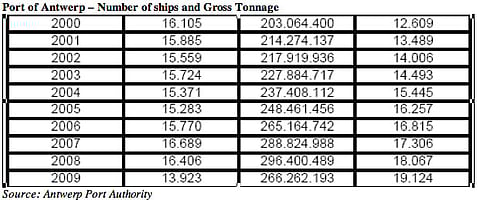
In terms of freight volume, Antwerp is the second-largest port in Europe, after Rotterdam. Antwerp is the third-largest Ro-Ro port in Europe, with extensive terminals where among other things new and second hand cars are loaded and unloaded. Antwerp is a market leader for exports of second hand cars and is also an important player for exporting trucks, thus reinforcing its position as a Ro-Ro hub. The port also acts as a shortsea hub for cars imported from all of Europe.
Excluding containers, 3.2 million tonnes of Ro-Ro freight was loaded and unloaded in Antwerp in 2009. Most Ro-Ro ships in the Port of Antwerp are handled on the left bank of the Scheldt, in the Verrebroek and Vrasene docks. The Port of Antwerp is the gateway to Europe, handling 157.8 million tonnes of freight in 2009.
In 2009 the Port of Antwerp handled 157.8 million tonnes of freight, with containers naturally playing a very important role. Last year a total container volume of 87.2 million tonnes was loaded and unloaded. Also during this period 39.5 million tonnes of liquid bulk and 14.7 million tonnes of dry bulk were loaded and unloaded. In the course of 2009, ships brought 10.4 million tonnes of conventional general cargo to and from the port of Antwerp, along with more than 3.2 million tonnes of Ro-Ro freight.
As a landlord port, Antwerp Port not directly involve in port operations. The port works with stevedores operating Ro-Ro terminals.
Katoen Natie sets the pace in value-added logistics and high-tech services in the field of port operations. Katoen Natie port operations handle over ten million tonnes per year.

The Port of Hamburg
Four large container terminals are available in Hamburg. Exports via Hamburg declined compared with the same period of last year, with a total of 48.2 million tons (-17.4 percent). The effects of the global economic slump hit general cargo, the dominant segment for the Port of Hamburg with 73.6 million tons (-24.8 percent), more severely than bulk cargo handling, which amounted to a total of 36.8 million tonnes (-13.4 percent) for 2009.
Container transhipments at the Port of Hamburg for the period under review totalled 71.2 million tons (-25.1 percent). In terms of TEU, this was equivalent to 7.01 million TEU (-28 percent).With 110 million tonnes of sea-borne cargo handled in 2009, a year impacted by the global economic and financial markets crisis, Germany's biggest universal port fell short of the previous year's result by around 30 million tons (- 21.4 percent). Improvements are in sight for 2010 and port-related industries anticipate a moderate level of growth.
The number of large container ships with a carrying capacity of more than 10,000TEU calling at the Port of Hamburg had already jumped from 29 to 69 in 2009.
The Bulgarian connection
In Bulgaria at the Port Rousse-East, a part of Rousse Port, a Ro-Ro platform is available, ferry pontoon with a draw-bridge, crane and additional equipment for operation with a large number different cargoes – coals, ore, wood, containers and automobiles.
Varna is the only place in the Black Sea region which has a rail ferry terminal with possibility to change the rail car bogies from European to Russian standard and vice-versa. This is a unique advantage of this terminal offering one of the shortest and the cheapest routes for the cargo traffic between Europe and Asia. The Varna Rail Ferry Complex is operated by the national shipping company Navigation Maritime Bulgare (Navibulgar) and the National Company BDZ (the Bulgarian Railways). The regular service to Ukraine and Georgia is provided by means of four ferry vessels with capacity 108 rail wagons or 920 trucks each.
The Ro-Ro line Burgas-Poti-Novorossiysk-Burgas was set up in 1996. It is a unique ferry line, connecting Europe with the Caucasus Region and Russia. The line is served by the ferry 'Sredetz', owned by SOMAT, and designed to transport different types of cars, containers, oversized and heavy loads, as well as hazardous goods (except for ADR class 7). The ferry can take up to 90 complete articulated trucks. Other vehicles can use this ferry link as well as our own trucks.
The Ro-Ro line is the most significant Bulgarian contribution to the development of the TRACEKA corridor (the Silk Road), connecting Western Europe through the Black and the Caspian Sea with Middle Asia and China.
SOMAT operates a fleet of four catamarans and two compound vessels, comprising two barges and a harbour tug. Thanks to them transportation of goods along the Danube River is being successfully carried out, guaranteeing regular sailing-off three times a week both from Passau and from Vidin. The transit period of a trip is five to six days. The storage capacity of the catamarans is 49 trailers.
North to Norway
The Port of Oslo handles over 500,000 tonnes of cement annually and up to 200,000 tonnes of grain a year. The total amount of ships/freight sums as below for 2008 for the Port of Oslo:
The Port of Oslo does not operate any purely Ro-Ro lines or terminals at the moment however three Ro-Pax ferry companies operate daily to Denmark and Germany and they carry some Ro-Ro cargo in addition to cars. These companies are:
South to Slovenia
The Port of Koper in Slovenia is a multi-purpose port, equipped and prepared for handling and warehousing all types of goods. The basic port activity is carried out at specialised terminals, which are technically and organisationally suitable for handling and warehousing of specific cargo groups.
The terminal has regular weekly lines to the Far East and is connected via feeder services with important hub ports in the Mediterranean (Gioia Tauro, Malta, Piraeus, Haifa, Taranto), which have regular connections with all continents in the world.
Regular railway connections are established with the most important trade centres in Central and Eastern Europe.
Back to Bruges
Zeebrugge, or Bruges by the sea, is a young seaport with modern port equipment suitable for the largest ships. The port is also one of the fastest growing ports in the range of ports between Le Havre and Hamburg, which together handle more than a billion tonnes of cargo a year.
Zeebrugge plays a prominent role as Ro-Ro port within Europe. More than one million trucks pass through the port every year. Daily more than 20 cargo vessels leave for the United Kingdom.
At the moment Zeebrugge can handle ships with a loading capacity of 14,000TEU (or a length of approximately 400 metres, a beam of 56 metres or 22 rows of containers). These assets have turned Zeebrugge into one of the fastest growing container ports in Europe.
An important part of the roro traffic is the handling of new cars, agricultural machinery and excavators. Zeebrugge safeguards its position of first car handling port in the world.
From January through November, Ro-Ro traffic decreased by 22 percent in comparison with the same period in 2008. The volume accounted for 8.7 million tonnes for all 2009 is 9.4 million tonnes. From January till November a volume of 1,165,267 units was handled. This constitutes a 41.6 percent decrease. After a difficult first half year, Zeebrugge container traffic grew in the second semester as a result of the growing deepsea traffic to the Middle and the Far East. Zeebrugge also saw a growing number of container feeder services, mainly to Scandinavia and the Baltic region.
From January till November the container traffic rose by 14.7 percent to 22.5 million tonnes.
Also, from January through November the Fluxys terminal handled 4.7 million tonnes of liquefied natural gas. (+112.5 percent). Seventy-six vessels called at Zeebrugge instead of 38 last year. The remaining liquid bulk dropped by 23 percent to 2.6 million tonnes. The total liquid bulk for 2009 was up 30 percent; conventional traffic grew by 2.7 percent to 809,625 tonnes.
From January till November 56 cruise vessels moored in Zeebrugge (instead of 41 in 2008) and the port handled a total cargo throughput of 40.8 million tons (+4.7 percent). The port expects a total cargo throughput in Zeebrugge of 44.4 million tonnes or a 5.7 percent rise in 2009, in comparison with 2008.
The Hanseatic Ports
The Ro-Ro terminal at the Port of Gdynia was inaugurated on August 1, 2001, and consists of three modern ramps, newely built or refurbished warehouses, sheds, and strengthened open storage areas. Since July 2009, the Port of Gdynia has started a contract with the Finnlines' Ro-Pax terminal for Star-class ships.
In the document "Strategy for the Port of Gdynia Development until 2015" endorsed by the General Assembly of the Port of Gdynia Authority in 2003, development of Ro-Ro handling operation is one of the three priorities, besides container and ferry handling. The Ro-Ro Terminal is a part of the net TEN-T Corridor VI whose development is one of the priorities, both in Poland's strategies and in European Union ones.
In 2010, estimated handling volume will reach two million tonnes. That is why the development of the handling potential is necessary. This investment will consist in the construction of a new ramp for Ro-Ro handling, construction of the road-railway system and of manoeuvre yards.
Port of Gothenburg
Ro-Ro handling in the Port of Gothenburg is characterised by a rapid goods turnover of rolling loads in their five terminals. The Port of Gothenburg largest Ro-Ro terminal has up till now been an integrated part of the port company, but as of February 1 became a private company, named Älvsborg Ro-Ro although still owned by the City of Gothenburg (as well as the Port company).
It is the ambition of its board to offer the concession of the Ro-Ro terminal to the market and hereby sign a long-term concession agreement with a licensee who will then take over the operation.
The services in the Älvsborg Terminal are frequent connections to the UK (north and south), Belgium, Finland (north and south) and Spain. Main cargo consists of forest products, vehicle industry, steel and consumer products. Ro-Ro activities also take part in other terminals in the port, such as the car terminal, mainly focusing on overseas Ro-Ro, and the Stena terminals where the ferry and freight shipping line Stena Line operate ferries, Ro-Paxes and pure freight Ro-Ros to Denmark and Germany transporting passengers as well as cargo.
All Ro-Ro customers in Gothenburg have a preference to unitised cargo and the main load carrying units are semitrailers, containers, cassettes, customised rolling units and trade cars.
The volume for 2009 totalled 504,000 Ro-Ro units and 157 000 trade cars.
Copenhagen Malmö Port
Copenhagen Malmö Port (CMP) services about 7,800 vessels a year. CMP has a new facility under construction. It has approximately 500,000 square metres of Ro-Ro terminal, container terminal and Combi terminal. The Ro-Ro facility include three berths.
Construction started May 2009 and will be completed April 2011. The US$118.6 million project includes three new terminals and will completely transform the Port in Malmö.
The City of Malmö is also establishing a logistics centre for industries dependent on transport in this part of the harbour. The project is co-financed by the European Union.
The dock at the new Ro-Ro terminal will be around 750 metres long. It will have a water depth of 8.5 metres, although this dock has also been prepared for an expanded water depth of ten metres. The terminal – which will be the hub for CMP's Ro-Ro activities – will be able to accommodate three ferries at the same time. Lorry ramps for main decks and upper decks are being built at two of these ferry berths. The third ferry berth will have a fixed ramp for main decks. The new Ro-Ro terminal also has setting-up areas for trailer and lorry handling of just over 100,000 square metres.
The existing terminals in CMP is used by DFDS Seaways (to Norway), DFDS Tor line (to Klaipeda), Polferries (to Poland)and Nordö Link (to Germany). Vessels are regular Ro-Ro vessels but Seaways has large ferries on the route.
The dramatic downturn in the global economy reduced total cargo volumes within CMP to 15 million tonnes (18), around 17 percent lower than the previous year. The biggest fall was within car distribution and ferry traffic. At the same time, some of CMP's business areas reported relatively stable development. During 2009, there was, for instance, a record number of cruises. Copenhagen received 335 cruise ships with almost 677,000 passengers, which confirms the city's position as the largest and most popular cruise destination in Northern Europe.
Picture of the port under construction. The picture shows the third Ro-Ro berth in front; next to that is the new container terminal and Combi terminal is in middle of the picture. The whole reclaimed area is 1.5 million square metres. Of these, half a million square metres is currently under construction and will be completed by April 2011.
The other one millions square metres is dedicated to logistics companies and that area will be taken into use after the terminals are completed.
Port of Aarhus
Port of Aarhus, Denmark has Ro-Ro facilities at the Inner Harbour for shiping company Mols-Linien and at the Multiterminal for the Ro-Ro traffic in Finland and the Baltic area. The port also has Ro-Ro facilities at the container harbour for very large vessels. The port has strengthened its position as Denmark's largest container port and currently has a market share of no less than 65 percent of the containers handled in Danish ports. The Port of Aarhus has 139 employees as at October 2009, while approximately 150 private companies at the port employ thousands of people.
At the ferry terminal, Pier 3, quay no. 71 is a Ro-Ro quay for Mols-Linien's combi ferries to Zealand. The shipping company is sailing between Aarhus and the two destinations Odden and Kalundborg on Zealand.
The two combi-ferries, 'Maren Mols' and 'Mette Mols' are sailing with cargo, busses, caravans, cars and passengers six times a day between Aarhus and Kalundborg. Transit time is two hours and 40 minutes. The catamaran ferries 'Max Mols' and 'Mai Mols' are sailing with buses, cars and passengers between Aarhus and Odden six times a day with a transit time of 65 minutes.
With approximately 900,000 containers handled each year Aarhus is an important hub in constant and continued growth.
At the multi-terminal in the Port of Aarhus there are different types of special equipment for handling all types of bulk goods, containers, general cargo etc.
Ro-Ro facilities in the Port of Aarhus are available at Pier 3, in the container harbour, in the multi-terminal and on Pier 3. Ro-Ro vessels from Finland, Sweden and Lituania are frequent users of the Ro-Ro quays.
The Port of Aarhus is ready to start the last part of the harbour's extension plan described in the revised Masterplan from 1997. This plan included further extension in the eastern part of the harbour.
The new harbour area is planned to be approximately 80,000 square metres and the title is Omni Terminal. This new area shall be used for storage of different types of cargo, which does not need to be kept under roof such as pebbles, stones and different types of bulk goods or wind mill projects waiting for shipment.
The city of Aarhus who is building the tunnel to the port, spend US$272.92 million on a completely new tunnel, a tunnel carrying the goods directly to and from the port – onto the European motorway network. The tunnel is expected to be completed in 2015.
The Port of Barcelona has two container terminals: Terminal de Contenidors de Barcelona (TCB) and Terminal Catalunya (Tercat). Tercat Hutchison will manage a 100-hectare container terminal, 1,500 metres of berthing line and a 16.5-metre draught at water level, with a total capacity to handle more than 2.65 million TEU per year. Terminal Ferry de Barcelona is the Ro-Ro terminal at the Port of Barcelona. With a 13-hectare surface, it has 1.26 metres of berthing line and five Ro-Ro ramps. In 2009 it was enlarged with US$49 million of investment.
Port Nou is a multipurpose terminal with five hectares of surface, 1,050 metres of berthing line and 2 Ro-Ro ramps.
South to Spain
In 2009 goods throughput at the Port de Barcelona fell to 42 million tonnes, which means a decrease by 17 percent. Container and finished vehicles have been specially knocked by the demand decline and the economic crisis. Port de Barcelona handled 1.8 million TEU in 2009, 29 percent less than in 2008. A closer look on the results reveals that exports have performed better (with a 15 percent reduction), while imports (-26 percent) and domestic traffic (-20 percent) have showed a poorer trend. However, transhipment (-43 percent) has register the biggest decline in containerised cargo.
Terminals specialised in finished vehicle logistics have handled 438,597 units in 2009. This is 38 percent down on 2008. Despite the strong decline, finished vehicle volumes have recovered during the second semester. In November and December this kind of product has shown increase by 15 percent.
The handling of cargo in Short Sea Shipping lines has fell by eleven percent to 341,173UTI (truck, platform, reefer van). Some specific services, such as the ones connecting Barcelona to Civitavecchia, Liorno or Porto Torres, have performed very well (+24 percent).
The Ro-Ro terminals at Barcelona Port have mainly two types of services: domestic regular lines connecting with Balear and Canary Island and SSS or Ro-Ro lines connecting to Italy (Genoa, Civitavecchia, Livorno, Porto Torres), North Africa (Tanger, Argel) and other Mediterranean destinations. Ships are both cargo vessels and ferries (cargo and passengers).
The Costa Wharf, which has been recently enlarged, will become a short sea shipping (SSS) terminal. The Port of Barcelona has opened a tender to hand this wharf to an operator who will build and manage the SSS terminal. The company that will be awarded the terminal will invest around US$27.3 million in this infrastructure.
Structure of cargo traffic 2000-2009 (in thousand tonnes)
Krasimir Krastanov
