VESSEL REVIEW | Himalayasan – LNG dual-fuel crude carrier for Japan's Camphor Tree Maritime
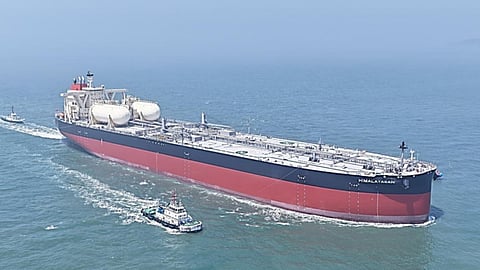
Camphor Tree Maritime, an affiliate of Japanese shipping company Mitsui OSK Lines, has taken delivery of a new very large crude carrier (VLCC) built by Dalian COSCO KHI Ship Engineering (DACKS) of China.
Himalayasan is notable for her dual-fuel propulsion system, which can run on both LNG and low-sulphur fuel oil.
DACKS parent company Kawasaki Heavy Industries (KHI) said that when using LNG as her primary fuel, the VLCC can generate emissions of up to 30 per cent for CO2, nearly 100 per cent for SOx, and 85 per cent for NOx compared to ships that operate on heavy fuel oil.
Advanced bow form to further reduce surface resistance
Himalayasan has an LOA of 339.5 metres (1,114 feet), a beam of 60 metres (200 feet), a summer draught of 21.1 metres (69.2 feet), a depth of 28.9 metres (94.8 feet), a deadweight of 310,026, a gross tonnage of 166,708, a total cargo capacity of 352,151 cubic metres (77.5 million gallons), and space for 37 crewmembers.
The VLCC’s design has replaced the conventional bulbous bow with a newly designed bow form that extends the vessel's length at the waterline. KHI said this new design can significantly reduce resistance from bow waves during navigation, thus enabling improvements in propulsive performance.
IMO Tier III-compliant machinery
The ship's MAN B&W 7G80ME-C10.5-GI-HPSCR main engine with a rated output of 22,600 kW (30,300 hp) at 63 rpm drives a large-diameter propeller to deliver a service speed of approximately 15.45 knots.
An exhaust gas aftertreatment system ensures compliance with IMO Tier III emission standards. Boilers from Alfa Laval Qingdao and Mitsubishi Heavy Industries Marine Machinery and Equipment are also fitted.
Himalayasan is registered to Panama and was built in compliance with ClassNK requirements.
