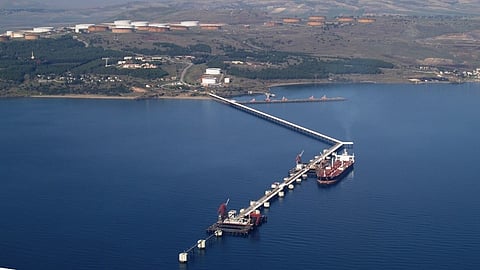


Israel's imports of Azerbaijani oil from Turkey's Ceyhan port hit a three-year high in 2025, ship-tracking data show, underscoring Israel's ability to secure supplies despite hostility from some governments over its war in Gaza.
Official Turkish data show that trade between Turkey and Israel has been zero since June 2024, after Ankara imposed a ban over Israel's war against Palestinian terror group Hamas.
Turkey does not control where Azerbaijani oil pumped through the Baku–Tbilisi–Ceyhan pipeline is sold, but said in November 2024 that exporters using Ceyhan, "respected its decision to end trade with Israel," and oil was not being loaded with Israel as the destination.
However, Kpler data shows that Israel's imports of Azerbaijani crude from Ceyhan jumped 31 per cent year on year to 94,000 barrels per day in 2025 - the highest since 2022 and widening a its lead over Russia, Israel's second-largest supplier.
The figures are the latest example of Israel continuing trade with businesses in countries where governments condemn its actions in Gaza. South Africa, which has accused Israel of genocide at the International Criminal Court, was its top coal supplier in 2025.
Israel's Ministry of Energy and Infrastructure said it does not comment on the sources of its oil imports. The government had said Turkey was ignoring international agreements with its trade ban.
Ships leaving Ceyhan to deliver oil to Israel typically switch off their trackers and signal other destinations to maritime authorities, Kpler and Vortexa analysts say, resulting in the shipments not being recorded officially.
"The vessel will typically signal offshore Egypt/Cyprus, and will discharge to Israel," Vortexa said, citing Aframax tanker Valfoglia, which loaded at Ceyhan and discharged 680,000 barrels of Azerbaijani Light crude in Israel on January 7.
Another vessel, Suezmax tanker Kimolos, loaded Azerbaijani crude at Ceyhan on December 31 and switched off its automatic identification system tracker between January 1 and 5, LSEG data show. Kpler data show it discharged on January 4 at Israel's Ashkelon port.
Turkey's energy ministry, in response to queries, referred to a 2024 statement saying that state-run pipeline operator BOTAS was not involved in the sale of Azerbaijani oil.
Azerbaijani crude accounted for 46.4 per cent of Israeli oil imports last year, the highest share this decade and far ahead of Russia on about 28 per cent, Kpler data show.
Imports from Nigeria more than doubled in 2025, but supplies from Brazil, Democratic Republic of Congo and Republic of Congo - which together made up more than 10 per cent in 2024 - fell to zero, according to Kpler and Vortexa.
(Reporting by Sudarshan Varadhan in Singapore; Additional reporting by Can Sezer in Istanbul and Steven Scheer in Jerusalem; Editing by Florence Tan and Mark Potter)
