

Russia has been unable to capitalise on this week's surge in global crude prices, as days of Ukrainian drone attacks and harsh winter storms have sharply curtailed its capacity to export oil, industry sources said.
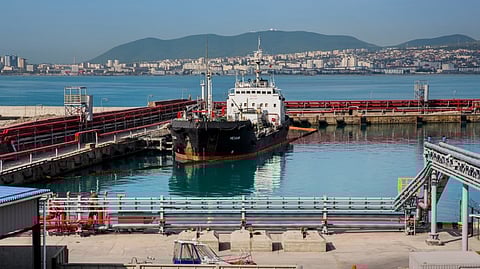
Russia's Sheskharis oil terminal in Novorossiysk port suspended oil loadings on Monday after a Ukrainian drone attack left a fuel terminal ablaze and damaged dozens of buildings, Russian and Ukrainian officials and three trade sources said.
Crude oil benchmarks rose about eight per cent on Tuesday, soaring for a third session as the US-Israeli conflict with Iran widens, disrupting fuel shipments and heightening fears of further Middle East oil and gas supply disruption.
Russia's federal budget deficit has been rising because of shortfalls in oil and gas revenue that make up nearly a quarter of budget proceeds.
Russian Urals oil prices in Baltic ports rose to $51.6 per barrel on Monday, the latest LSEG data showed, with traders expecting further gains on Tuesday. Yet Russian exporters have been unable to respond and boost shipments as Ukrainian drone strikes and severe weather have disrupted operations at key facilities, traders said.
The Sheskharis oil terminal, slated to load some 500,000 barrels per day of oil this month, remained shut on Tuesday, and it was not clear when loadings would resume. One trading source said he expected Sheskharis to restart loadings by March 5-6 at the earliest.
Russia's main oil pipeline operator, Transneft, and the Novorossiysk port authority did not immediately respond to requests for comment. Exporters were also unable to divert more crude to the Baltic ports of Primorsk and Ust-Luga, where severe icy conditions have sharply reduced loading capacity, traders said.
European authorities have also stepped up the seizure of so-called "shadow fleet" tankers used for Russian oil, adding further complications. Such tankers operate with opaque ownership and lax safety standards.
Options to reroute crude through the Caspian Pipeline Consortium (CPC) pipeline are limited, as it faces weather-related delays and much of its capacity is used by Kazakhstan, whose Tengiz field is recovering output. Flows through the Druzhba pipeline—supplying Hungary and Slovakia—remained halted.
The two countries have blamed Ukraine for the suspension, while Kyiv says the pipeline was damaged by Russia and cannot operate. Still, in the far east, Russian oil exports are near record highs, with Kozmino port expected to load about one million barrels per day in March, traders said.
(Reuters reporters; Editing by Bernadette Baum)
