

A looming Russian diesel export ban could not come at a worse time. Global fuel inventories are dangerously low, and after the biggest energy shock in decades, another supply hit could threaten a fragile recovery.
Russian President Vladimir Putin said on Sunday that the Kremlin was considering a ban on diesel exports after acknowledging mounting domestic shortages.
Those shortages were triggered by Ukrainian drone strikes on Russian refineries, part of Kyiv's widening energy campaign against Moscow in the fifth year of the Ukraine war.
The energy-dense fuel sits at the heart of global economic activity, powering heavy transport, industry and agriculture — from trucks and shipping to construction machinery and tractors.
The market is still recovering from the closure of the Strait of Hormuz, which choked off oil supplies when the Iran conflict erupted on February 28.
With 13 per cent of global oil supplies cut off, diesel prices surged to all-time highs in early April, as a sudden supply crunch triggered acute shortages and drained already thin global inventories.
The strait's reopening after the June 17 US-Iran interim deal has brought swift relief. Tanker traffic remains uneven and well below pre-war levels, but trapped Persian Gulf barrels are flowing again, helping drive a more than 40 per cent retreat in Brent crude prices and offering hope to the stretched refined products market.
But just as the worst of the Middle East energy shock begins to fade, a new disruption is emerging in an old conflict.
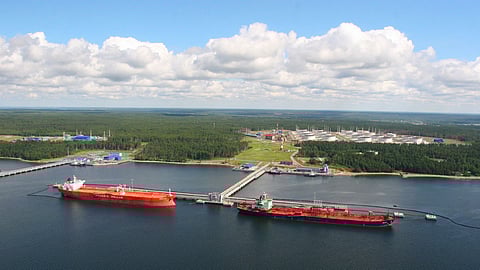
Russia's threatened diesel export ban highlights its own increasingly strained position. The world's third-largest crude producer — and a major diesel supplier — has sustained significant damage to its energy infrastructure in recent months as Ukraine has intensified attacks on oil terminals and refineries across the country.
Moscow’s key refinery has been hit twice this month and is expected to remain offline for at least six months. Altogether, the strikes are estimated to have disrupted around a quarter of Russia's roughly seven million barrel-per-day (bpd) refining capacity.
The impact is already visible domestically: fuel prices have risen and long queues have formed at filling stations across parts of the country.
Russia may even be forced to import fuel, according to local media reports. That would represent a remarkable reversal for a country that has long been a cornerstone supplier of refined products to global markets.
The hit to exports is already stark. Russian seaborne diesel shipments have fallen sharply in recent months, dropping to 426,000 bpd in June, the lowest since at least January 2017, according to Kpler data. That’s down from 827,000 bpd a year earlier, when Russia was the world's second-largest diesel exporter after the US, accounting for 11 per cent of global seaborne supply.
Turkey and Brazil remain the largest buyers, with the rest flowing primarily to Africa. A full export ban would therefore reverberate far beyond Russia’s borders, especially given the timing.
This threatened ban comes as global inventories of refined products have fallen to alarming levels, after being drawn down at a rapid pace in the past few months to compensate for missing Middle Eastern volumes.
In the US, distillate stocks, which include diesel and heating oil, are hovering just above a 23-year low of around 100 million barrels hit in May, according to Energy Information Administration data. Inventories elsewhere tell a similar story.
Diesel stocks in northwest Europe, a major diesel-importing region, have dropped by roughly 20 per cent since the start of the Iran war, according to Insights Global, leaving the region with little buffer against fresh supply shocks.
Moreover, the market is now entering a critical period when inventories are typically rebuilt ahead of winter in the Northern Hemisphere, when demand rises due to heating needs, freight activity and agriculture.
Diesel refining margins are already flashing red. In Europe, benchmark diesel refining margins — known as cracks — have jumped more than 35 per cent since the US-Iran interim deal, reversing earlier declines and rising above $46 a barrel, according to LSEG data. Singapore cracks in Asia are also back above $40 a barrel.
To be sure, the gradual normalisation of crude flows from the gulf should allow major Asian refineries to raise run rates after months of disruption, helping to ease some of the tightness in global fuel supplies.
But that relief may prove insufficient.
If Russia pulls even more barrels off the market, the fragile rebalancing now underway could quickly unravel. The result would be renewed upward pressure on diesel prices, further inventory depletion and higher costs for transport, industry and consumers.
After one of the most severe energy shocks in decades, the global economy can ill afford another.
(Writing by Ron Bousso; Editing by Marguerita Choy)
