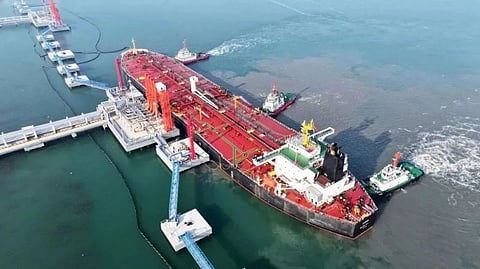


The Iran war is starting to shape China's imports of major commodities, with April data showing a sharp decline in crude oil but rising trade in metals. The headline-grabbing number from the figures released last week by customs was the slide in arrivals of crude oil, with the world's biggest importer taking in 9.37 million barrels per day (bpd), the lowest in almost four years.
April's imports were down 20 per cent from the same month in 2025 as seaborne imports from the Middle East declined sharply amid the effective closure of the Strait of Hormuz since the US and Israel attacked Iran on February 28.
China received just 648,000 bpd that came through the Strait of Hormuz in April, according to data compiled by commodity analysts Kpler, down from an average of 4.07 million bpd in the three months from January to March.
March and April would have seen the last of the tankers that exited the strait prior to the start of the conflict discharge in China, although some vessels have made it out in recent weeks despite both the United States and Iran effectively saying the narrow waterway is closed, or under blockade.
Another factor to consider when assessing China's crude oil imports is price, and the drop in April fits the pattern of the past decade of increasing imports when prices drop and declining arrivals when they rise.
The sharp rise in crude prices after the start of the conflict would have deterred China's refiners from buying their usual volumes, especially since prices for physical cargoes soared to levels well above futures for a period of several weeks.
Brent futures reached a 2026 high of $126.41 a barrel on April 30, up 74 per cent from the close of $72.48 on February 27, while some physical cargoes traded at premiums of around $40 over futures at that time.
The drop in China's crude imports has helped ease a squeeze in crude supply in Asia, which was the destination for about 80 per cent of the volumes that came through the Strait of Hormuz prior to the war against Iran.
But this is more of a happy coincidence for other crude importers in Asia rather than any sign of altruism on China's part.
With at least 1.2 billion barrels of crude being held in commercial and strategic stockpiles, it makes economic sense for China's refiners to cut imports when prices are elevated, especially since the widespread market expectation is that they will fall sharply once, or if, the strait is fully re-opened.
If China were being altruistic it would be using its massive crude stockpile to boost exports of refined fuels, where tight supply has seen prices for diesel and jet fuel rise to record highs.
Instead, China's exports of refined products dropped to 3.1 million tonnes in April, down 33 per cent from March and the lowest in a decade as Beijing opted to keep fuel for domestic market use.
This informal restriction on product exports may be eased this month, but there have been no formal announcements.
It could be that Beijing has recognised that fuel shortages in its neighbours will eventually blow back on its own economy, or it may be that refiners have pushed to resume exports because of the fat margins on offer, particularly for middle distillates.
Higher profits are also likely the motivation behind a spike in China's exports of aluminium, which jumped 15 per cent in April from the same month last year to 598,000 tonnes.
Aluminium prices in London have jumped 14 per cent since the day before the Iran war started to end at $3,579.50 a tonne on Monday, as the conflict cut about eight per cent of global supply from producers in the Middle East.
One commodity where China's imports are showing resilience is iron ore, with April arrivals of 103.9 million tonnes being down slightly from March's 104.74 million, but actually slightly up on a per day basis at 3.46 million from March's 3.38 million.
The strength in iron ore imports isn't because steel production or exports are rising, as both are dropping with production down 4.6 per cent in the first quarter and exports sliding 9.7 per cent in the first four months of the year from the same period in 2025.
Rather it seems that China is stocking up on iron ore, potentially to lift inventories in case shipping becomes constrained by tightness in the supply of fuel oil as refineries in Asia struggle to source sufficient crude.
Stockpiles of iron ore at Chinese ports, as monitored by consultants SteelHome, dropped to 161.4 million tonnes in the week to May 8.
This was down from the record high of 166.9 million tonnes in mid-March, but even with the decline the current level is still higher than at any previous point in history, and also 14.2 per cent above the 141.3 million tonnes from the same week last year.
(By Clyde Russell, Editing by Christian Schmollinger)
