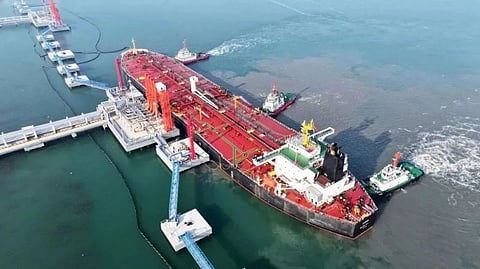


The volume of Venezuelan oil already headed to China before the US seized a tanker off the South American country’s coast last week, plus a glut of crude in storage and weak demand, will limit the near-term impact of the move in the Chinese market, traders and analysts said.
Exports from the South American producer have fallen sharply since the US seized a tanker off Venezuela’s coast and imposed new sanctions on shipping firms and vessels doing business with it, with the prospect of further seizures deterring shipments.
China, the world’s number one oil importer, is the biggest buyer of Venezuelan crude, though Venezuelan supply accounts for only around four per cent of its total crude imports.
Venezuelan oil arrivals to China are on track to rise this month and next, traders and analysts say, thanks to a spate of exports over the previous four months, deepening discounts on crude that can take up to 60 days to reach the independent refiners that are its main buyers.
"The surge in Venezuela flow to China increased in anticipation of sanctions," said Mukesh Sahdev, founder CEO of energy consultancy XAnalysts. He predicted that the impact of the tanker seizure, and any additional sanctions or seizures, would be seen in February.
December China arrivals of Merey crude, Venezuela’s main export grade, are expected to exceed 600,000 barrels per day, according to analysts at tanker tracker Vortexa. Kpler puts December Merey arrivals at 664,000 bpd, subject to revision, which it said would be a record.
The Venezuelan supply comes on top of ample deliveries from other sanctioned producers Russia and Iran, which have led to mounting volumes of oil in floating storage in Asia.
Asian floating oil storage hit 71 million barrels last week, rising from 53 million barrels at end-October and about 33 million barrels in early September, Kpler data showed, adding to pressure that had deepened discounts on Venezuelan crude.
At least one-third of the estimated 650,000 bpd of Merey discharged in November in China is still looking for end-buyers, said Vortexa analyst Emma Li. Two trade sources said plentiful Russian and Iranian supply, along with barrels on the way to China from Venezuela, had limited market worries for now.
Another trading manager at a regular buyer said it would take time to gauge the impact of the seizure on supplies, but that his company had shifted to buying "small amounts" of Canadian TMX crude to hedge against geopolitical risk.
While the slice of the Chinese market supplied by Venezuelan crude is relatively small, for those that do buy the Merey grade - chiefly independent "teapot" refiners - alternatives can be costly and not immediately available.
Only about half a dozen of these small refiners are regular buyers of Venezuelan oil, industry sources have said, but these could incur costs for supply losses and securing alternatives.
China’s demand for Merey is at a seasonal low, with the most-traded bitumen futures on the Shanghai Futures Exchange trending downward since late October. The contract has risen for three sessions since Thursday, but total gains were less than one per cent.
The extra-heavy Merey is much cheaper than similar grades such as Canada’s Access Western Blend and Colombia’s Castilla.
(Reporting by Chen Aizhu and Siyi Liu in Singapore; Editing by Tony Munroe and Jan Harvey
