
Oil prices fell more than seven per cent on Monday as talks between Iranian and Qatari officials lifted hopes for an end to the US-Israeli war with Iran and stabilisation of Middle East crude supply.
Iran's president said the supreme leader had granted the government "certain authorities" regarding peace talks. The country's negotiators held days of talks with Qatari mediators aimed at ending the war. A draft proposal is being circulated with a follow-up meeting possible, an official briefed on the talks said.
Brent crude futures fell $8.47, or 7.47 per cent, to $104.96 a barrel by 12:24 EST (17:24 GMT). US West Texas Intermediate crude was down $7.50, or 7.2 per cent, at $96.62.
The session low for Brent was $104.49 and for WTI it was $96.44, with analysts citing hopes for a diplomatic breakthrough after Iranian President Masoud Pezeshkian said Supreme Leader Ayatollah Mojtaba Khamenei had granted the government certain authorities for peace talks.
Pezeshkian added Tehran, "will try to resolve the problem with dialogue", without elaborating, according to state media.
Signs of progress in US-Iran talks pushed oil prices lower, Raymond James analyst Pavel Molchanov said, noting, however, that scepticism is warranted after many "false dawns” over the past several months.
Brent ended October at its highest in six months on concerns that the Middle East conflict could escalate again after Tuesday's US midterm elections.
"The oil market is still reacting with extreme sensitivity to every headline out of the Middle East," UBS analyst Giovanni Staunovo said. "While fears of an imminent escalation pushed prices up last week, they have dropped sharply at the start of this week as diplomatic talks between the US and Iran continue," he added.
Iranian Foreign Minister Abbas Araqchi said on Sunday that the purpose of the talks was to continue consultations with the Qatari mediators, adding that Tehran was prepared for "both defence and diplomacy".
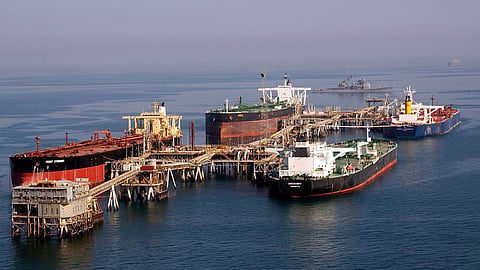
The talks followed a recent increase in attacks on oil tankers passing the Strait of Hormuz, though there have also been signs of shipments rising from some major exporters.
Saudi Arabia's crude exports increased in October from September, two of three ship-tracking companies said, despite attacks by Iran-aligned Yemeni Houthis on its energy infrastructure.
The outbreak of the Iran war at the end of February has depleted oil stocks.
The world has drained nearly one billion barrels from inventories since the war disrupted shipping through the Strait of Hormuz, said Sultan Al Jaber, chief executive of ADNOC, Abu Dhabi's state-owned oil company.
Oil could rise further, some analysts said. Goldman Sachs on Sunday, citing elevated supply, and said Brent could jump to $140 in 2027 if Persian Gulf oil output remains 3.5 million barrels per day below its 2025 average.
"Intensified shipping attacks, damage to oil infrastructure, and a more persistent risk premium remain the key triggers of potential upside," the bank said in a report.
(Reporting by Nicole Jao and Alex Lawler Additional reporting by Ahmad Ghaddar, Florence Tan and Trixie Yap Editing by Louise Heavens, David Goodman, Xevi Fontdegloria and David Gregorio)