

Brent crude futures rose slightly on Monday after attacks by Yemen's Iran-aligned Houthis on a Yemeni military training camp and renewed attacks on Saudi energy, airport and military facilities.
Brent crude futures rose 17 cents, or 0.15 per cent, to $110.03 a barrel at 13:08 ET (17:08 GMT), after falling more than $3 earlier in the session as investors booked profits following last week's rally to a five-month high.
US West Texas Intermediate was up $1.68, or 1.66 per cent, to $103.09 a barrel in relatively thin trade ahead of the October 20 expiry of the front-month contract. The benchmark was on track for its highest settlement since September 15.
Trading activity was concentrated in the more liquid December contract, with more than 195,000 lots changing hands, compared with about 26,000 lots in the expiring November contract.
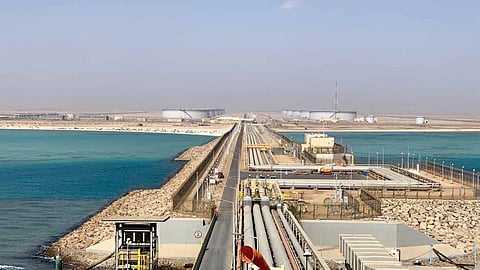
Yemen's Houthis said on Monday they had carried out attacks on Saudi energy, airport and military targets, including an Aramco facility in Yanbu, the Shaybah oilfield, King Khalid International Airport in Riyadh and Abha airport.
Saudi authorities did not immediately confirm the claims and Reuters could not independently verify them.
Separately, an oil tanker caught fire and exploded after striking a naval mine in the southern Strait of Hormuz on Sunday, Iran's Revolutionary Guards said, according to Iranian media.
The attacks added to concerns over energy supplies from the Persian Gulf.
Increased threats to commercial shipping cut crude flows through the region to a seven-day average of about 8.5 million barrels per day last week, down from more than 20 million bpd the previous week, analytics firm Kpler said. The firm reported at least 10 confirmed incidents involving commercial vessels during the week.
"Ongoing strikes on vessels transiting the Strait of Hormuz and flows remaining below pre-conflict levels continue to support prices," UBS analyst Giovanni Staunovo said.
Meanwhile, SEB analyst Bjarne Schieldrop predicted increases in export volumes through Hormuz may prove short-lived as Iran could escalate attacks ahead of the November 3 US midterm elections.
Egypt said it stood ready to support Saudi Arabia against the Houthis, though Egypt's parliament delayed until October 26 a vote that would authorise the armed forces to assist the kingdom if requested to do so.
Saudi Arabia's civil defence authority issued a series of alerts on Monday, warning of potential danger in several areas, including Riyadh, before later saying the threat had passed.
Earlier on Monday, 53 people were killed in a Houthi attack and 200 were injured on a Yemeni Government security force training camp in the energy-rich Shabwa province in coastal south-central Yemen.
As he seeks to lower energy prices ahead of the November elections by increasing supplies, US President Donald Trump on Friday signed an executive order waiving some sanctions and tariffs related to Russian energy exports.
"The waiver raises the prospect of additional Russian fuel exports, but uncertainty over its implementation and duration limits confidence in a sustained supply increase," Gelber and Associates wrote in a note.
Priyanka Sachdeva, head of market insight at Phillip Nova, said the waiver did little to address the physical supply disruptions in the Strait of Hormuz, where oil tanker attacks continue.
Despite international efforts to curb energy flows from Iran and Russia, both countries have continued exporting fuel, which has limited the impact of supply disruptions on global markets.
Oil output from the Organisation of the Petroleum Exporting Countries, rose in September, a Reuters survey found, led by gains in Saudi Arabia and Iraq.
(Reporting by Siddharth Cavale in New York; Robert Harvey in London and Florence Tan in Singapore; editing by Barbara Lewis Editing by Kirsten Donovan, Nick Zieminski and Barbara Lewis)
