

Oil prices declined on Tuesday as investors focused on signs of recovering crude exports from the Middle East and lingering concerns over potential supply disruptions in the region stemming from the US-Israeli war on Iran.
Brent crude futures were down $1.38, or 1.3 per cent, to $103.88 a barrel at 13:03 ET (17:03 GMT). US West Texas Intermediate crude was down $2.04 or 2.16 per cent at $90.58.
Brent and WTI are headed for monthly gains of around 15 per cent and 5.7 per cent, respectively.
Crude futures were, "under pressure this morning on news that the Saudi’s East/West pipeline flows have moved up...US/Iran negotiations are also continuing and while seemingly far apart, both are looking for an off-ramp, and as more oil flows through the Middle East, the less bargaining power Iran will have," said Dennis Kissler, senior vice president of trading at BOK Financial.
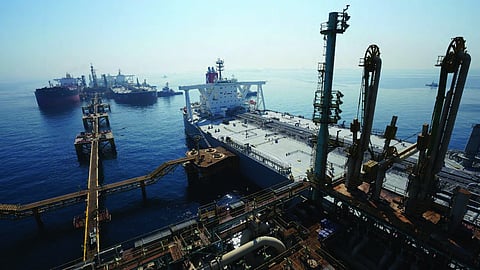
Saudi Arabia resumed oil tanker loadings from its Red Sea port of Yanbu after restarting operations on the East-West Pipeline, according to trade sources and shipping data, improving the outlook for oil exports from the Middle East.
Crude oil exports from key Middle East producers have also rebounded in September to 16.328 million barrels per day, the highest since the US-Israeli war on Iran started in late February, data from Kpler showed on Monday.
US President Donald Trump said he has offered Iran nothing to end the war, rejecting media reports that cited US officials saying he was willing to ease sanctions and release frozen funds for "concrete" steps regarding Iran's nuclear programme.
Diesel futures in Europe edged lower on Tuesday, while those in US traded one per cent higher.
The White House has urged the European Union to draw down diesel emergency inventories in a bid to lower global prices, sources said.
Several European Union member countries have not released as much oil and refined products from reserves as they promised, President Donald Trump's administration said.
Trump is considering regulatory relief that would allow broader sales of red-dyed diesel as part of an effort to bring down soaring prices, according to two people familiar with the discussions who noted that such a move that could allow some buyers to avoid the federal fuel tax. The proposal emerged as a leading alternative to a diesel export ban.
US crude oil and gasoline inventories were expected to have fallen last week, while distillate stockpiles were likely unchanged, a preliminary Reuters poll showed on Monday.
(Additional reporting by Enes Tunagur in London, Sumit Saha in Bengaluru and Trixie Yap in Singapore; Editing by Louise Heavens, Jan Harvey and David Gregorio)
