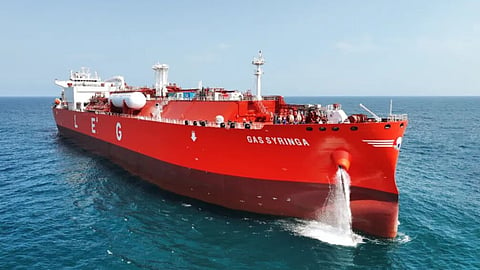
VESSEL REVIEW | Gas Syringa & Gas Iris – Chinese owner's VLECs boast dual-fuel propulsion and enhanced cargo tank safety features
China’s Jiangnan Shipyard recently delivered two new very large ethane carriers (VLECs) in a series to local customer Southwest Shipping.
Designed in-house by Jiangnan Shipyard, Gas Syringa and Gas Iris each have an LOA of 230 metres (750 feet), a beam of 36 metres (120 feet), a draught of 8.2 metres (27 feet), and a deadweight of 61,500.
The liquefied gas cargo is kept in B-type tanks with a total capacity of 99,000 cubic metres (3.5 million cubic feet), thus placing the ships among the largest VLECs ever built.
Large dimensions coupled with improved safety and cargo-carrying versatility

The ships may also be used for the transport of LPG and ethylene in addition to ethane, thus allowing them to serve a greater number of markets.
The cargo tanks themselves have meanwhile been designed to ensure that any cracks in the structure would not immediately result in leakage, thus giving the crew more time to address potential issues than is otherwise possible.
Designed to minimise losses due to boil-off
The propulsion arrangement on each ship includes a shaft generator and a dual-fuel main engine that can also run on ethane. Other notable systems include those to ensure reduced boil-off rate to minimise instances of cargo loss due to evaporation while in transit.
Management of Gas Syringa and Gas Iris will be the responsibility of Wideshine Management of Singapore, hence their being flagged to Singapore. According to Chinese media, the VLECs have been tailored for long-distance transportation of ethane in the United States and are compatible with a number of major LPG terminals around the world.
