

US natural gas futures climbed about two per cent to a 35-month high on Wednesday on record flows to liquefied natural gas (LNG) export plants and forecasts for colder weather and higher demand over the next two weeks than previously expected.
Limiting gains were record output, ample amounts of gas in storage and lower gas prices in Europe and Asia due mostly to the possibility that peace talks in Ukraine could result in the lifting of sanctions against Moscow. That could allow Russia, the world's second-biggest gas producer behind the US, to export more gas in the future.
Front-month gas futures for January delivery on the New York Mercantile Exchange rose 11.9 cents, or 2.5 per cent, to $4.959 per million British thermal units (mmBtu), putting the contract on track for its highest close since December 27, 2022.
That price increase also pushed the front-month back into technically overbought territory for the third time in four days.
Meteorologists forecast temperatures across the country will remain well below normal through December 9, with the most frigid weather expected on Thursday. Extreme cold this week has already driven cash gas prices to their highest levels since January 2024 in New England and California and their highest levels since February at the Henry Hub benchmark in Louisiana and in Pennsylvania, Chicago and New York.
LSEG said average gas output in the Lower 48 states has risen to 109.7 billion cubic feet per day (bcfd) so far in December, up from a monthly record of 109.6 bcfd in November.
On a daily basis, however, output was on track to drop by 2.4 bcfd to a one-week low of 108.9 bcfd on Wednesday since hitting a daily record high of 111.3 bcfd on November 28.
Record output has allowed energy companies to stockpile more gas than usual, leaving about five per cent more gas in storage than normal for this time of year.
LSEG projected average gas demand in the Lower 48 states, including exports, would fall from 145.1 bcfd this week to 142.9 bcfd next week. Those forecasts were higher than LSEG's outlook on Tuesday.
Average gas flows to the eight big LNG export plants operating in the US have risen to 18.4 bcfd so far in December, up from a monthly record high of 18.2 bcfd in November.
Freeport LNG's export plant in Texas was on track to take in more gas on Wednesday in a sign that one of the plant's three liquefaction trains has returned to service after shutting on Tuesday.
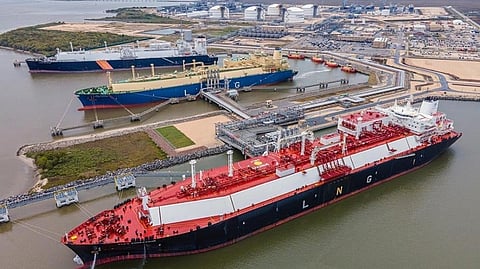
The Imsaikah LNG vessel remained anchored near Exxon Mobil/QatarEnergy's 2.4 bcfd Golden Pass LNG export plant under construction in Texas, according to LSEG data and analyst comments.
The ship is carrying LNG from Qatar that traders and analysts say will be used to cool equipment as part of the commissioning of the plant. The facility is expected to start producing LNG later this year or early next year.
The US became the world's biggest LNG producer in 2023, surpassing Australia and Qatar as surging global prices fed demand for more exports, due in part to supply disruptions and sanctions linked to Russia's 2022 invasion of Ukraine.
Around the world, gas prices held near an 18-month low of around $10 per mmBtu at the Dutch Title Transfer Facility (TTF) in Europe on hopes of a possible peace plan for Russia and Ukraine, while prices at the Japan-Korea Marker (JKM) in Asia slid to a three-month low near $11.
(Reporting by Scott DiSavino; Editing by Paul Simao)
