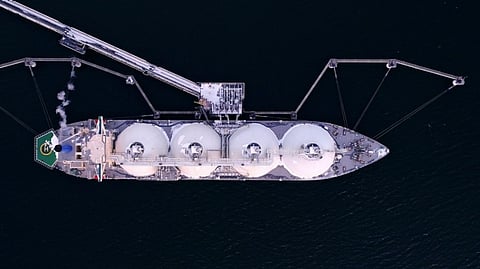


A vessel carrying US liquefied natural gas has sailed directly from the US to China for the first time since trade tensions between Washington and Beijing effectively halted direct shipments, vessel-tracking data showed.
However, analysts say it may never enter China as the terminal's bonded storage facilities allow re-exports without import duties.
Carrying a cargo loaded in early June from US energy firm Venture Global LNG's Plaquemines export plant in Louisiana, the Al Fat'h LNG tanker arrived at the PipeChina Yangpu terminal in China's southern island province of Hainan on Wednesday into Thursday, according to vessel-tracking data from Kpler and Vortexa.
It is the first direct shipment since the Mu Lan offloaded at Zhangzhou in February 2025, before retaliatory tariffs imposed by Beijing and Washington made such imports uneconomic.
At least three LNG vessels have travelled from the US to other countries first before ultimately dropping some small amounts of LNG in China - one in 2025 and two so far in 2026, according to data from the US Department of Energy and financial firm LSEG.
However, the cargo's arrival does not necessarily mean China will take in the imported LNG, said Vortexa market analyst Florence Yu.
"Yangpu port has bonded LNG storage tanks as part of Hainan's special customs operations strategy. These are actually China's first LNG storage tanks approved for bonded operation, allowing LNG to be stored, traded, and re-exported without paying Chinese import duties," she said.
"Chinese players have great flexibility under this condition. The cargo can be resold later for portfolio optimisation or, if domestic supply becomes critical, it can still be imported into China after clearing customs."
The tanker is controlled by QatarEnergy, which bought the cargo on a spot basis from Plaquemines for delivery to China, according to Kpler data.
"We believe it might not enter China's domestic gas market, even though it was technically unloaded in Yangpu. The bonded tank status makes re-export quite likely. Besides, domestic demand remains weak in China, especially in industrial sectors," said Nelson Xiong, analyst at Kpler.
"It makes more economic sense for them to re-export to other countries given high Asian LNG prices and wider profit margins," Xiong said.
Gas was trading at a three-month high near $20 per million British thermal units (mmBtu) at the Japan Korea Marker (JKM) benchmark in Asia, topping prices of roughly $18 in Europe and $3 in the US.
China, the world's largest LNG importer, has several bonded storage sites for LNG across the country, including at Tianjin and Zhoushan.
It had previously been a major buyer of US LNG, with Chinese companies still holding long-term contracts to purchase US supplies. But Chinese importers have been diverting these US-sourced cargoes to buyers elsewhere, as the tariffs have raised import costs.
China suspended a 24 per cent additional tariff on US goods for one year, but retained a base tariff of 10 per cent imposed in November. Tariffs on US energy products, including a 15 per cent levy on LNG, also remain in place.
The US is the world's largest exporter of LNG, shipping out 109 million tonnes of the fuel last year, according to Kpler data.
(Reporting by Emily Chow in Singapore, Scott DiSavino in New York and Sam Li in Beijing; Editing by Lincoln Feast and Emelia Sithole-Matarise)
