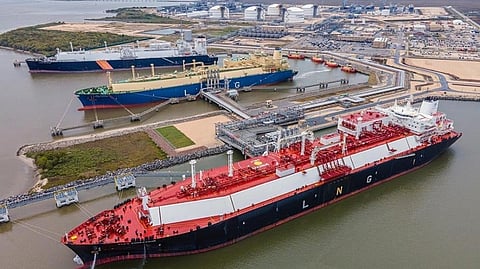


US liquefied natural gas exports rose in September as stronger European demand lifted prices and encouraged producers to maximise output despite maintenance outages at one export facility.
Berkshire Hathaway Energy said in September it was shutting its Cove Point LNG export plant in Maryland for about three weeks of annual autumn maintenance.
American LNG exports climbed to 10.9 million tonnes in September from 10.7 million tonnes in August, according to preliminary data from financial firm LSEG.
Exporters are taking advantage of elevated global gas prices and improving operating conditions along the US Gulf Coast, where cooler temperatures reduced heat-related constraints that weighed on production during the summer months.
Europe remained the largest destination for US LNG. Buyers continued heavy imports as they sought to refill storage sites ahead of the winter heating season, supporting prices and attracting cargoes that might otherwise have gone to Asia and Latin America.
The region imported 5.91 million tonnes, or 54 per cent of total US exports, in September, up slightly from 5.8 million tonnes in August, according to preliminary LSEG ship-tracking data.
Asia increased its purchases of US LNG to 2.84 million tonnes, or 26 per cent of exports, from 2.59 million tonnes in August as robust regional prices continued to attract cargoes.
The Dutch Title Transfer Facility benchmark averaged $25.42 per million British thermal units in September, up from $21.17 in August, according to LSEG data. That pushed the European benchmark slightly above the Japan-Korea Marker, which averaged $25.39/mmBtu in September compared with about $22/mmBtu in August.
Egypt remained a significant buyer of US LNG last month, importing 0.68 million tonnes, or just over six per cent of total exports.
Latin America imported 0.53 million tonnes of US LNG in September, sharply lower than the 0.9 million tonnes purchased in August. The decline coincided with a surge in exports from Trinidad and Tobago, which shipped about 1.1 million tonnes of LNG during September, its highest monthly export volume in more than two years.
The increase in Trinidadian supply appeared to displace some US cargoes that would typically serve the Latin American market, allowing more US LNG to flow to higher-priced destinations in Europe and Asia.
Canada's newest LNG exporter continued ramping up operations, with LNG Canada exporting approximately one million tonnes in September. All those cargoes were delivered to Asian markets, underscoring the project's strategic positioning on Canada's Pacific Coast and its ability to serve Asia without transiting the Panama Canal.
(Reporting by Curtis Williams in Houston; Editing by Nathan Crooks and Nia Williams)
