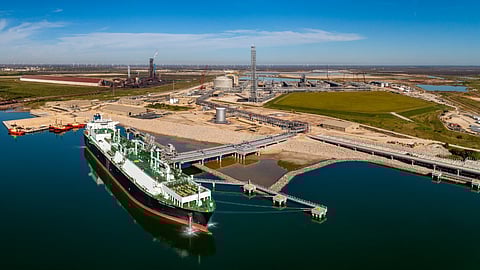


US exports of liquefied natural gas rose more than 17 per cent last month from a year earlier as Venture Global's Plaquemines plant in Louisiana ramped up production and Cheniere brought on more units at its Corpus Christi facility, preliminary data from financial firm LSEG showed.
The US is the world's largest LNG exporter, and there are already signs of even higher output to come in March, positioning it well to fill supply gaps at a time when LNG exports from Qatar have been disrupted due to the Iran war.
In February, the US exported 9.94 million tonnes of the gas, up from 8.2 million tonnes for the same period in 2025, the preliminary data showed. However, exports fell from 11.3 million tonnes in January and were down from December's record of 11.5 million tonnes on account of the shorter calendar month.
Plaquemines accounted for two million tonnes of the flows, up from 600,000 tonnes last year, while Corpus Christi exports rose from 1.3 million tonnes in the same month last year to 1.8 million tonnes.
Golden Pass, a joint venture between QatarEnergy and Exxon Mobil, is expected to produce first LNG this month, and Venture Global said its Plaquemines facility could produce seven million tonnes more than it is authorised to export.
With prices at the Dutch Title Transfer Facility at $11.23 per million British thermal units and the Japan-Korea Marker JKM at $10.82 per mmBtu, Europe had slightly higher prices than Asia and remained the market of choice for US LNG.
The US exported 7.66 million tonnes of LNG to Europe, or 77 per cent of total sales, compared to 9.46 million tonnes, or 83 per cent of the total in January, LSEG ship tracking data showed.
Exports to Asia grew to 970,000 tonnes, or just above 9.7 per cent of total US LNG exports, up from 690,000 tonnes, around six per cent of the total in January. Exports to Latin America increased slightly to 520,000 tonnes, from 490,000 tonnes in January.
Egypt, which has moved from a net exporter of LNG to a major buyer because of natural gas shortages, bought 500,000 tonnes in February, the same as it did in January, the data showed.
(Reporting by Curtis Williams in Houston; Editing by Nathan Crooks and Sonali Paul)
