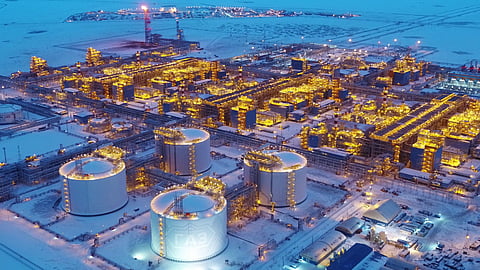

European Union countries imported record-high volumes of liquefied natural gas from Russia's Yamal facility in the first half of this year, EU data showed on Monday, ahead of a ban on Russian supplies that will take effect next year.
The EU from April banned Russian LNG imports under short-term contracts, but imports under long-term contracts can continue until January 1, 2027.
EU countries imported 136 cargoes containing 9.97 million tonnes of LNG from Yamal in January-June, a 16 per cent increase in volume from the same period last year, according to the data from commodities intelligence firm Kpler.
The Yamal LNG project in Russia's western Arctic is controlled by private Russian firm Novatek. China's CNPC and France's TotalEnergies also own stakes.
More than 97 per cent of the Yamal facility's deliveries between January and June went to EU ports, according to analysis by campaign group Urgewald. It said it showed the extent of Europe's support for Russia's LNG sector, even as the EU backs Ukraine in its war against Russia.
"It is absorbing almost the entire output of one of Russia's most strategically important LNG projects," Urgewald said.
EU purchases of LNG from Yamal between January and June had an estimated value of €5.96 billion ($6.82 billion), Urgewald said. The three biggest delivery destinations were France, Belgium and Spain.
As it sought to choke off Russia's means to fund its war on Ukraine, the EU agreed to ban all Russian gas imports following Moscow's 2022 full-scale invasion. The ban takes a step-wise approach to give companies time to secure alternative supplies.
The final deadline to end pipeline imports is September 2027.
The Yamal deliveries reflect a broader trend of Europe increasing Russian gas imports this year.
EU imports of Russian pipeline gas increased seven per cent year-on-year in January to May 2026, while Russian LNG imports rose by 11 per cent, according to the EU Agency for the Cooperation of Energy Regulators.
It said reasons for the increase included companies front-loading deliveries ahead of the EU ban, and the EU banning trans-shipments of Russian LNG in 2025, meaning more volumes remain in Europe rather than being shipped onwards to other countries.
(Reporting by Kate Abnett; editing by Barbara Lewis)
