

Soaring European natural gas prices, driven by the Iran war, threaten to inflict a fresh round of economic pain on the continent just as it races to rearm, build out its AI capabilities and fend off intensifying competition from China. The damage could be long-lasting.
Benchmark European gas prices climbed to €75 per megawatt hour (MWh) last week, more than double their level a year ago. They hit their highest level since late 2022, when Russian President Vladimir Putin's full-scale invasion of Ukraine prompted Europe to cut off vast volumes of Russian pipeline gas.
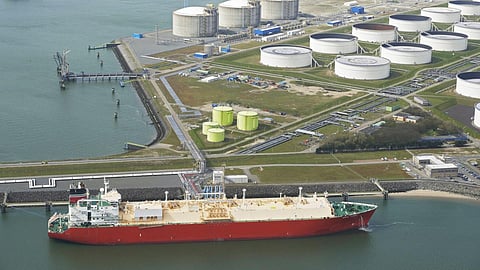
This latest crisis stems from the closure of the Strait of Hormuz more than six months ago, a disruption that has largely choked off around a fifth of global liquefied natural gas (LNG) supplies and tightened markets worldwide.
The resulting supply crunch sparked fierce competition between Europe and Asia.
A scorching summer across much of Asia lifted demand for power and cooling. As a result, large volumes of gas that would typically have gone to Europe were instead diverted eastward during the critical summer months, severely disrupting Europe's efforts to refill its vast underground storage network ahead of the winter heating season.
The consequences are now becoming evident.
European gas storage sites are currently around 66 per cent full, the lowest level for this time of year in 15 years and roughly 12 percentage points below last year's level, according to Gas Infrastructure Europe data.
Inventories typically peak in early November. In 2025, they topped out at 83 per cent, or around 85 billion cubic metres (bcm). This year, storage levels are likely to peak at only 70 per cent to 75 per cent, according to ROI estimates.
The situation becomes even more concerning when examining individual countries.
Germany's storage network, the largest in Europe, is only 54 per cent full, while storage facilities in the Netherlands, another critical regional gas hub, stand at just 48 per cent of capacity.
Entering winter with inventories at such low levels will increase both countries' dependence on spot LNG cargoes and pipeline imports from neighbouring states, putting further upward pressure on gas prices across the region.
The massive disruption to Middle Eastern exports is unlikely to ease soon.
LNG exports from the Persian Gulf, primarily from Qatar but also from the United Arab Emirates, fell by more than 85 per cent between March and August compared with a year earlier, according to Kpler data.
The disruption is likely to persist through the end of the year as shipping traffic through Hormuz remains constrained. QatarEnergy has already notified key customers that it has extended its force majeure suspension on LNG deliveries until early November.
Yet the global LNG market was supported by rapid production growth elsewhere, particularly in the US and Canada. According to the International Energy Agency, LNG production outside the gulf grew by 18 per cent, or around 27 bcm, in the year to the end of June, offsetting roughly 75 per cent of the losses from the Middle East.
That helps explain why prices, while at painful levels, remain far below the extraordinary peaks reached during the 2022 energy crisis, when benchmark European gas prices briefly exceeded €300 per MWh.
Nevertheless, given the current backdrop, the upside risk at current levels is enormous.
Finding a solution to this predicament is far from straightforward.
Previous attempts by governments, including Germany's, to intervene in gas markets have often backfired, distorting incentives and delaying refilling efforts. At the same time, reducing dependence on gas through greater use of renewables and nuclear power is a long-term project that will take years, if not decades, to fully deliver.
Nor are European governments in a position to repeat the massive subsidy programmes deployed after the 2022 shock.
Europe's gas bill reached €117 billion in 2025, even as consumption remained around 17 per cent below pre-crisis levels, according to Bruegel estimates. With prices now substantially higher, the region's import bill is likely to rise sharply again this year.
All of this leaves Europe's economy in a vulnerable position at precisely the wrong moment.
Tensions with Moscow are spiking, with an attempted Russian drone attack on Germany last week, while the Trump administration is pressing Europe to spend more on its own defence. In turn, the continent is seeking to rapidly expand production of ammunition, military equipment and other defence technologies.
At the same time, Europe is scrambling to make up ground in the AI arms race, where it finds itself far behind the US and China. Catching up requires heavy investment in power-hungry data centres.
Meanwhile, Europe’s manufacturing sector is finding it harder to compete with China. European carmakers, in particular, have lost significant ground to their lower-cost Chinese competitors. Struggling German auto giant Volkswagen recently announced the biggest restructuring in its 89-year history.
Another prolonged surge in gas and power prices would worsen Europe's cost disadvantage relative to rival economies. Manufacturers would either have to absorb higher energy costs, squeezing profits and investment, or pass them on to consumers, reducing their competitiveness.
In short, expensive energy threatens to undermine the very ambitions Europe sees as essential to its future economic and strategic autonomy.
The European Commission said on Friday that despite low storage levels, the bloc faces no immediate risk to security of supply this winter. That may well prove correct.
But the real issue is not whether Europe can secure enough gas to get through the winter. It is how much it will have to pay. For now, it looks like a cost the region cannot afford.
(Ron Bousso; Editing by Marguerita Choy)
