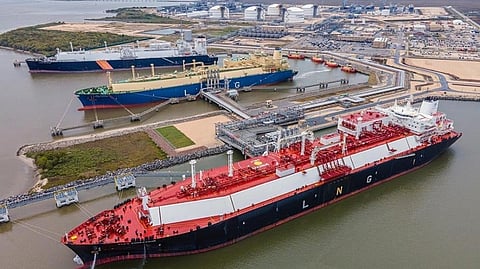


American LNG producers were unable to take advantage of a rally in global gas prices in July as maintenance and seasonally lower production kept export volumes largely unchanged from the previous month.
US exports of liquefied natural gas slipped to 10.48 million tonnes in July from 10.6 tonnes in June, according to preliminary data from financial firm LSEG.
Exporters traditionally use summer months for maintenance, since warmer weather makes it less efficient to supercool natural gas into liquid form. This year was no exception, with plants — including the country's third-largest export facility, Freeport LNG — taking the opportunity to do maintenance.
The stagnant production came as buyers in both Asia and Europe paid significantly more for LNG. The Asian benchmark Japan Korea Marker averaged $19.10 per million British thermal units in July, maintaining a premium over Europe's Dutch TTF benchmark, which averaged $18.07 per mmBtu, according to LSEG data. In June, TTF averaged $13.19 while JKM averaged $17.33 per mmBtu.
"US projects in the last year or two have been running above nameplate capacity and although they would like to produce more, they are not prepared to defer maintenance and risk having unscheduled maintenance down the road," Jason Feer, head of business intelligence at Poten and Partners, told Reuters on Monday.
Europe remained the largest destination for US cargoes as the continent continued to replenish gas inventories ahead of winter. Shipments to Europe rose to 4.76 tonnes in July from 4.41 tonnes in June, accounting for nearly half of all US LNG exports.
Asia retained its position as the second-largest market, taking 3.32 tonnes of LNG, up slightly from 3.25 tonnes the previous month. Although the stronger JKM premium typically encourages traders to divert cargoes towards Asia, the limited growth in exports suggests sellers had little uncommitted supply available to respond to the arbitrage opportunity.
Latin America emerged as one of the few regions posting stronger growth in purchases from the US in July. Exports to the region climbed to 1.07 tonnes from 0.96 tonnes in June as winter demand in the Southern Hemisphere increased, with Brazil leading buying activity.
The increase came despite additional competition from Trinidad and Tobago, where Atlantic LNG's Train 4 returned to service and shipped more than 0.5 tonnes of LNG to Latin American markets during the month, according to LSEG ship-tracking data.
Egypt, which has become an increasingly important destination for US LNG this year as it seeks to alleviate domestic gas shortages, remained a major buyer. Imports, however, fell from a record 1.06 tonnes in June to 0.63 tonnes in July, although the country remained among the largest individual purchasers of US cargoes.
Elsewhere, one cargo was delivered to Senegal, while several vessels carrying a combined 0.63 tonnes of LNG were still at sea at the end of July and had not yet declared a final destination, according to LSEG data.
(Reporting by Curtis Williams in Houston; Editing by Nathan Crooks and Deepa Babington)
