VESSEL REVIEW | Aurora Borealis – Ammonia-ready VLGC to facilitate Canadian LPG exports
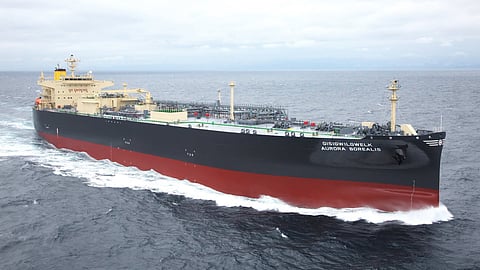
Kawasaki Heavy Industries delivered the LPG-fuelled very large gas carrier (VLGC) Aurora Borealis to Singapore-based shipowner Kumiai Navigation on October 29, 2026. The ship was built at Kawasaki's Sakaide Works in Kagawa Prefecture.
Kumiai Navigation, part of Tokyo-headquartered Kumiai Senpaku, has fixed the vessel on a seven-year time charter to Canada's AltaGas. Ship manager Fleet Management said she will carry LPG from Canada's west coast to Japan and other Asian markets.
She follows sister ship Aurora Guardian, which joined the AltaGas charter in April.
The ship has separate cargo tanks that allow LPG and ammonia to be carried simultaneously.
Aurora Borealis has an LOA of 229.9 metres (754.3 feet), a moulded beam of 37.2 metres (122 feet), and a moulded depth of 21.9 metres (71.9 feet). The moulded draught is 11.65 metres (38.22 feet) and the summer draught is 11.681 metres (38.323 feet).
Deadweight is 56,375, gross tonnage 49,561, and net tonnage 14,869. She is classed by ClassNK with the notation LGC 2G and is registered in Singapore.
Cargo capacity is 87,058 cubic metres (19 million gallons), up from the 84,000 cubic metres (18 million) of Kawasaki's earlier LPG carriers.
Kawasaki said it kept the principal dimensions, including LOA and beam, close to the dimensions of conventional vessels so the carrier can berth at major LPG terminals worldwide.
Flexible dual-fuel propulsion

Propulsion is provided by a single electronically controlled, Kawasaki-MAN B&W 6G60ME-C10.5-LGIP two-stroke engine rated at 14,530 kW (19,490 hp) at 88 rpm, which delivers a service speed of about 17 knots. The ME-LGIP engine injects LPG in liquid form, with pilot fuel starting combustion. It can also switch to very low-sulphur fuel oil and MGO, and operation on ammonia is possible following future modification.
The fuel capacity is 2,702.8 cubic metres (594,530 gallons).
A shaft generator supplies onboard electricity from the main engine's output. According to Kawasaki, this allows the diesel generators to be shut down during normal navigation, so the ship operates on LPG, with only a small amount of pilot fuel in addition. The auxiliary plant meanwhile comprises five 7,675kVA generators and an Osaka boiler.
Kawasaki said LPG operation cuts SOx and CO2 emissions compared with conventional marine fuel oil and enables compliance with EEDI Phase III. The propulsion system meets IMO Tier III NOx limits using exhaust gas recirculation and selective catalytic reduction. This means the ship can operate in NOx emission control areas even on conventional low-sulphur fuel.
Energy-saving devices suitable for trans-Pacific crossings
Fuel consumption is minimised with the aid of Kawasaki's rudder bulb system with fins (RBS-F), a semi-duct system with contra fins (SDS-F) mounted forward of the propeller, and energy-saving fins around the propeller. Kawasaki quoted general reductions of two to seven per cent in required propulsive power for RBS-F and three to seven per cent energy savings for SDS-F.
Fleet Management said the vessel also has an adaptive control for energy-saving autopilot.
AltaGas Executive Vice President and President of Midstream Randy Toone said the acquisition of Aurora Borealis is part of the company’s expansion of its export platform and fleet, though which infrastructure will be built, “to deliver Canadian energy to global markets for decades to come."