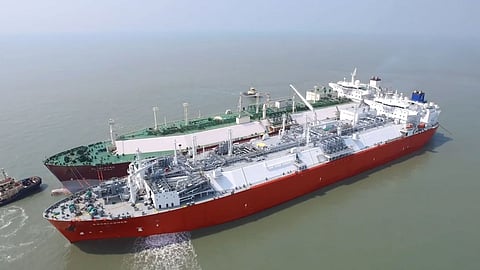


Bangladesh on Thursday approved a Chinese proposal to build the country's third floating liquefied natural gas (LNG) terminal, expanding import capacity as a persistent gas shortage weighs on power generation and industry.
The move comes as Bangladesh faces a widening gap between gas demand and supply and growing reliance on imported LNG, while conflict in the Middle East raises concerns about supply disruptions and price volatility.
The Cabinet Committee on Government Purchase, chaired by Finance Minister Amir Khosru Mahmud Chowdhury, approved a proposal from China's state-owned China National Energy Engineering and Construction (CNEE) to develop the facility, according to a Finance Ministry statement.
The floating storage and regasification unit (FSRU), to be built at Maheshkhali in Cox's Bazar district under a government-to-government arrangement, will have regasification capacity of 600 million cubic feet per day (mmcfd), rising to 750 mmcfd at peak capacity. Operations are expected to begin in 2028.
The government will pay BDT123.24 billion ($987.9 million) over 15 years or BDT131.61 billion over 20 years. CNEE proposed a daily service fee of $342,000 under the 15-year option, about 35 per cent higher than the fee paid to US-based Excelerate Energy and 37 per cent above that of Summit LNG.
Bangladesh's two existing LNG terminals at Maheshkhali have combined capacity of 1,100 mmcfd. The new facility would raise that to 1,700 mmcfd, or 1,850 mmcfd at peak output.
The proposal was pulled from a purchase committee meeting in October for further review of its financial terms before winning approval on Thursday.
The decision follows the interim government's cancellation in October 2024 of a separate agreement with Summit Group to build another 600 mmcfd floating LNG terminal in Maheshkhali. State-owned Petrobangla terminated the deal over procurement concerns, a move challenged by Summit.
Bangladesh's gas demand is estimated at around 3,800 mmcfd, compared with supply of roughly 2,700 mmcfd from domestic production and LNG imports, leaving the country increasingly dependent on imported fuel to bridge the gap.
(Reporting by Ruma Paul. Editing by Mark Potter)