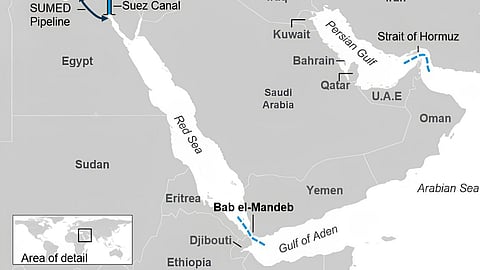


Oil prices rose by three per cent on Friday after the US and Iran stepped up attacks across the Persian Gulf, with shipping threatened by a potential Red Sea closure on top of the restricted traffic through the Strait of Hormuz.
Brent crude futures rose by $2.49, or 2.96 per cent, to $86.72 a barrel by 11:50 ET (15:50 GMT). US West Texas Intermediate futures were up $2.48, or 3.14 per cent, at $81.43.
For the week, both benchmarks were headed for a 14 per cent increase, with Brent on track for a third consecutive weekly gain and WTI set for its second. Diesel refining margins hit record highs on Friday, with low-sulphur gasoil futures touching $66.25 over Brent crude.
The Middle East is a major diesel exporter and the Hormuz closure, as well as attacks on oil refineries, have tightened fuel markets and bolstered prices globally. The broken truce between the US and Iran has resulted in a drop in oil flows out of the strait.
Iran, meanwhile, has pressed the Houthi terrorist group to close the Red Sea route if the US strikes Iran's power infrastructure.
"Given that so much of Saudi Arabia’s exports have been redirected to the port of Yanbu via the East-West Pipeline to avoid Hormuz, any such development is a threat indeed," Tamas Varga, analyst at PVM Oil Associates, wrote in a note.
Iran said it launched more strikes on US facilities in the Middle East on Friday, including the first direct attack in Syria, after a sixth straight night of US strikes on Iranian military facilities.
American forces had begun a new wave of strikes against Iran to further degrade Iranian military capabilities, US Central Command said on Thursday.
"Oil security is still a critical issue," International Energy Agency Executive Director Fatih Birol said on Thursday at a Council on Foreign Relations event in Washington.
"We should be worried, and I am worried, if the situation does not improve in the next few weeks," he said.
Meanwhile, Qatar's defence ministry said its armed forces thwarted an Iranian missile attack early on Friday and the interior ministry said a child was injured by shrapnel resulting from interception operations.
One of Kuwait's power generation and water desalination stations was hit by an Iranian attack, Kuwait's electricity ministry said on Friday.
In a different conflict zone, Ukraine's military said on Friday it struck a Russian oil refinery in the Yaroslavl region on Thursday.
(Reporting by Nicole Jao in New York, Robert Harvey in London, Mohi Narayan in New Delhi and Helen Clark in Perth Editing by David Goodman and Philippa Fletcher)
