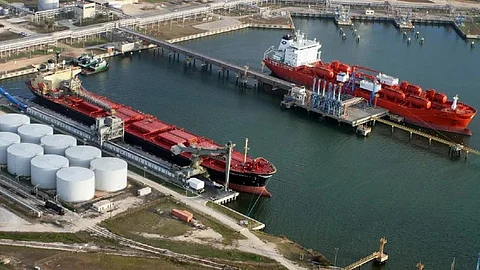


Tanker freight rates soaring to record highs are putting US crude oil out of reach for Asian refiners, pushing them to seek alternatives from the Middle East and Latin America, according to multiple traders and shipbrokers who track those markets.
The cost of chartering a very large crude carrier (VLCC) to carry two million barrels of US oil from the Gulf of Mexico to China in November hit $80 million this week, according to data from shipbrokers Simpson, Spence Young on LSEG.
This means the economics of moving the oil on that route are no longer viable, closing the so-called arbitrage window for the trade, the traders and shipbrokers, who spoke on condition of anonymity as they are not authorised to speak to the media, said this week.
Instead, Asian refiners are considering switching to Murban crude from the United Arab Emirates, causing the grade's premium to rebound to over $11 a barrel to Dubai quotes on Thursday.
At $40 a barrel, versus $8.60 before the US-Israeli war on Iran began in February, the shipping costs are equal to nearly half of the current price of a West Texas Intermediate crude future contract, sharply raising costs for refiners in the top oil importing region while shipowners reap bumper profits.
US oil sellers were expected to cut offers to compete globally while some trading firms were switching to smaller-sized tankers, according to three traders and a shipbroker.
"This dizzying rise in freight rates translates to a higher delivery cost of crude into the Asian refineries," said June Goh, senior analyst at Sparta Commodities, adding that product cracks would need to remain elevated to keep the overall refining margin positive.
Japanese refiner Cosmo Oil has provisionally chartered a VLCC for $81 million to load US oil on November 19-21, according to two traders and two shipping sources.
But attempts by South Korean refiner SK Energy and Trafigura to book VLCCs for $76 million to $77 million were unsuccessful, according to one of those people, a shipbroker.
Trafigura has chartered the Aframax tanker Torm Hilde — capable of carrying about 600,000 barrels — for $24 million to load US oil for Japan on November 1 while Vitol's fixture for Aframax tanker Riverside to load US oil for South Korea in early November for $27 million did not go through, the shipbroker said.
Trafigura declined to comment while the other companies did not immediately respond to requests for comment.
Steady demand for tankers on this route and expectations of the further release of US strategic petroleum reserves were supporting freight rates, said another of the sources, a shipping analyst.
Sparta's Goh said VLCC freight rates on the US Gulf to Asia and on the Fujairah to East routes have spiked more than 300 per cent since mid-August.
"The reasons for such exorbitant increases in VLCC freight rates are the hugely inefficient ship-to-ship (STS) activities as a workaround to the Strait of Hormuz closure and increased Atlantic Basin arbitrage crudes into the Far East, leading to lower open tonnage available," she said.
An oil analyst with a trading firm said Murban was about $2 a barrel cheaper than WTI crude on a delivered basis to Asia.
Hence, Asian refiners may buy more Murban or other alternatives such as Medanito from Argentina, the traders said, although some of them may still pay up for US oil for supply security.
"The diversification angle for crude supplies remains in play while the flow from the Strait of Hormuz can still be disrupted, which means even if the arbitrage looks shut, there will likely be more Atlantic crude flows into Asia," Sparta's Goh said.
(Reporting by Florence Tan; Editing by Christian Schmollinger)
